The Structural Ontology of the Human Being
When we cast our gaze outward, scanning the horizon of the known universe, what do we actually see? We see the sweeping vastness of the cosmos, the intricate proliferation of species, the clustering of tribes, the huddling of groups, and the intimacy of families. In this order, we witness life handling the relentless friction of change. What we do not see—what nature does not permit—is a "species of one."
Yet, when we stand before a mirror and look inward, our perception narrows. We see a solitary face. We see one unique specimen of a mammalian species. We tell ourselves that we are a singularity, a sovereign point of consciousness independent of the world around us.
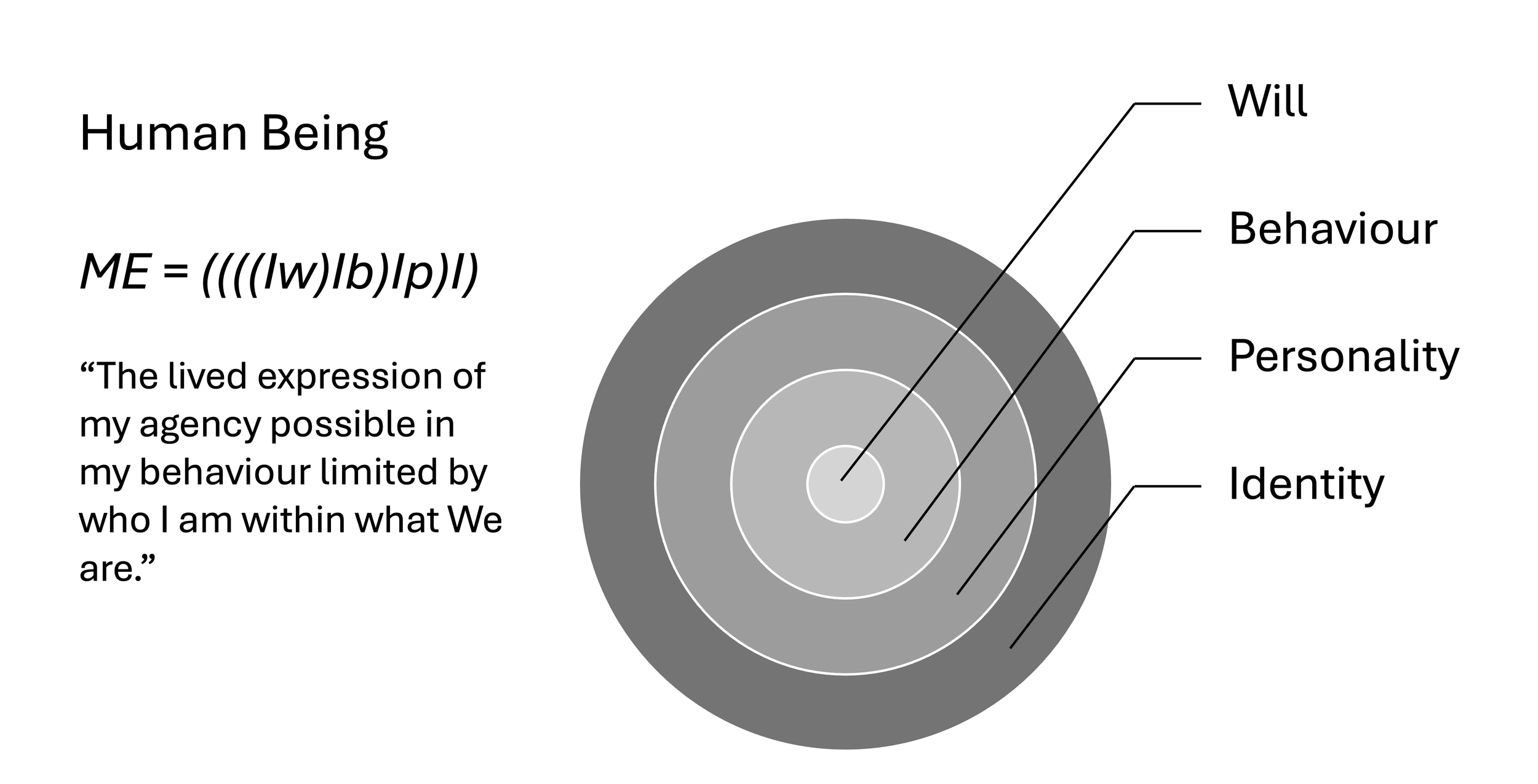
This is our primary error. If we are to understand the truth of our existence, we must admit that we are never a single dimension. We are, by necessity, a plurality. To be human is to be a composite structure, a nested hierarchy of forces acting in concert. This is the structural ontology of the human being.
To define "ME"—that concept we hold so dear—we cannot simply ask who we are. We must answer four distinct interrogations: What am I? Who am I? How am I? And to what extent am I?
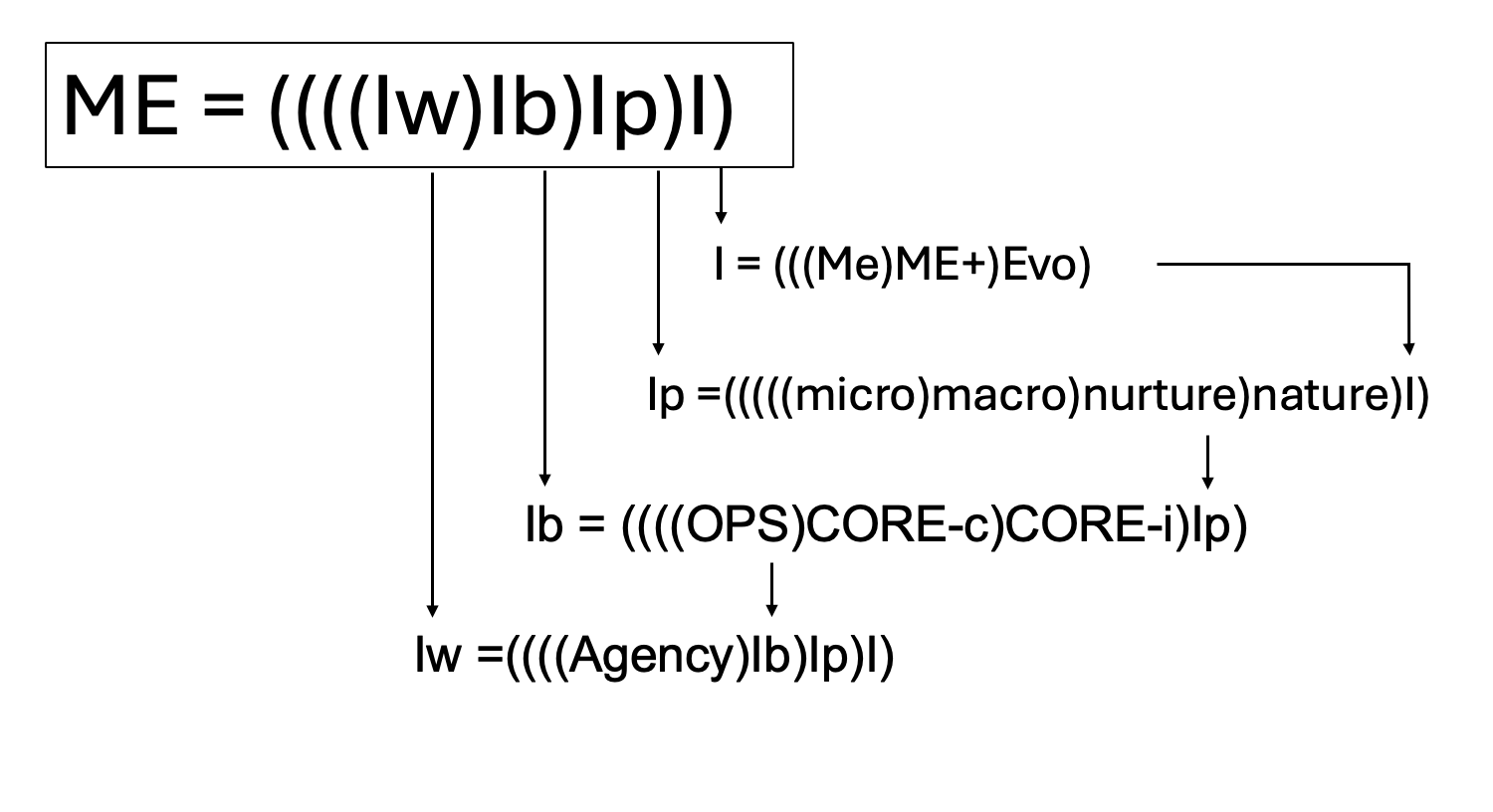
The mathematical synthesis of these questions yields a definition of the self that is far heavier, and far more connected, than our modern individualism allows: ME is the lived expression of my will, possible in my behaviour, limited by who I am, within what WE are.
The First Stratum: Identity (What We Are)
At the foundation lies Identity (I) We often mistake identity for a static object, a soul trapped in a jar of skin. But in this structural framework, identity is a dynamic tension defined by the formula:
I = (((Me)ME+)Evo)
The "Me" is the individual aware unit, the biological and psychological organism. But this "Me" is powerless in a vacuum. It requires a nest. This nest is the "ME+"—the collective field. It is the web of relationships, the tribe, the nation, and the shared reality in which the "Me" is embedded. We are not merely connected to the group; we are of the group. The "Me" is not the connection, nor the connected; it is the Connectedness itself.
Furthermore, both the self and the tribe are constantly swept forward by "Evo"—the vector of time and change. Identity, therefore, is not a noun; it is a verb. It is the act of a consciousness swimming within a collective, carried by the current of time.
The Second Stratum: Personality (Who We Are)
If Identity is the species, Personality ( I )is the uinque specimen. It is the unique variation of nature and nurture. Of genetics and environment. Family ( Micro ) and environment (Macro)
Ip =(((((micro)macro)nurture)nature)I)
Nature is the hardware—the genetic endowment that imposes the hard limits of maximum capacity. Nurture is the software—the training and environmental influence that determines how well that hardware functions. This relationship is merciless in its logic: the finest training in the world cannot transform a person into an Olympian if the genetic potential does not exist. Conversely, a toxic environment can prevent a potential Olympian from ever reaching the starting line. Personality is the specific configuration of these limits.
The Third Stratum: Behaviour (How We Are)
How does this personality manifest in the real world? It acts through the mechanism of Behaviour (Ib) We are not beings of pure reason; we are layered entities operating on three concurrent planes.
Ib = ((((OPS)CORE-c)CORE-i)Ip)
At the deepest level, we are driven by CORE-i, the Instinctive Core. This is our ancient, mammalian operating system, governing safety, fear, hunger, and the visceral need for tribal belonging. It speaks in the language of the nervous system: stress, panic, and calm.
Above this sits CORE-c, the Cultural Core. This is the layer of meaning—the "Why." It houses our narratives, our traditions, and the moral horizon that tells us what is true and what is good.
Finally, there is OPS, the Operational Layer. This is the "How." It is the machinery of modern life: bureaucracy, markets, logistics, and the daily routine. Our behaviour is the complex interaction of a singular personality filtering its actions through these three competing layers.
The Fourth Stratum: Will (To What Extent)
This brings us to the final, and perhaps most humbling, realization: the question of Will (Iw)
Iw =((((Agency)Ib)Ip)I)
We like to believe our Will is absolute. But if our behaviour is co-driven by ancient instincts and inherited culture, our Will cannot be all-defining. Agency is merely the fraction of our behaviour that is induced by the Operational layer—the part we can consciously steer.
Will, therefore, is defined as the amount of agency I can possess within my behaviour. It is the tip of the iceberg, visible above the water, while the massive weight of biology and culture drifts beneath the surface.
The Synthesis
When we reassemble these components, the image in the mirror changes. We are no longer looking at a solitary, sovereign individual. We are looking at a "ME" that is inextricably bound to a "WE."
We are biological organisms (Nature) shaped by our environment (Nurture), driven by ancient instincts (CORE-i) and sacred stories (CORE-c), attempting to navigate a technical world (OPS) through the limited aperture of our conscious agency (Will).
We are not "species of one." We are complex, nested systems of belonging. To understand oneself is not to look inward at a singularity, but to look outward at the structures that hold us, recognizing that we exist only because we are bound.
Truth. Definition for validation
The definition of truth as “the condensed centre of the zone of impossible deniability” sets the standard by which the ontology can claim validity. Truth, in this sense, is not “whatever we assert with confidence,” but whatever cannot be denied without collapsing coherence, credibility, or practice. An ontological claim about the human being is true only if, once fully understood, serious denial becomes structurally impossible without self‑damage.
Applied to the ontology, this definition forces each layer to justify itself. The basic identity claim—that any human “I” is Me‑in‑ME+‑in‑Evo—must reach a point where denying it undermines our ability to make sense of language, social life and temporality. If Me were not always already in some WE, in some temporal horizon, then core features of self‑understanding, recognition, and narrative would become inexplicable. When denial of that structure erodes the intelligibility of everyday practices, the identity formula meets the truth criterion.
The same holds for the deeper stratification into Identity (I), Personality (Ip), Behaviour (Ib via CORE‑i / CORE‑c / OPS), and Will (Iw). Each stratum is treated as a hypothesis about necessary structure. To count as true, it must be shown that if one drops a layer—say, CORE‑i instincts or CORE‑c meanings—whole families of phenomena (fear, belonging, guilt, obligation, norm‑guided action) can no longer be described without contradiction or ad hoc rescue devices. When denial of a layer forces such distortions, that layer has reached the zone of impossible deniability.
Finally, the same truth definition underwrites the ontology’s limit concepts: meaning as the state of no lack of meaning, value as distance from no‑meaning, freedom as the usable bandwidth of Will. These are not poetic choices but structural proposals. They are validated when attempts to redefine meaning, value, or freedom without regard to these limits systematically fail to account for how human lives orient, erode, or hold. In that sense, the definition of truth is not an ornament on the ontology; it is the internal tribunal before which every structural claim must stand.