[Hs = (Is(Ip(Ib(Ia(Iw)))))]
A lot is happening to us. To our societies. And to ourselves.
To cope, to manage, more than ever, we need to understand
Because after centuries of thinking, we still don’t.
“Have we been asking the wrong questions?”
“Have we missed some?” Is “Who Am I?” enough?
No, it takes many more.
“What am I?”
“Who am I?”
“How am I?”
“What drives me?”
“In how far can i be?”
What is our species like? Who am I as one specimen ? How do I behave? And how much of that is will?
This is the answer to those questions. The Structural Ontology of what it takes to be human.
[Hs = (Is(Ip(Ib(Ia(Iw)))))]
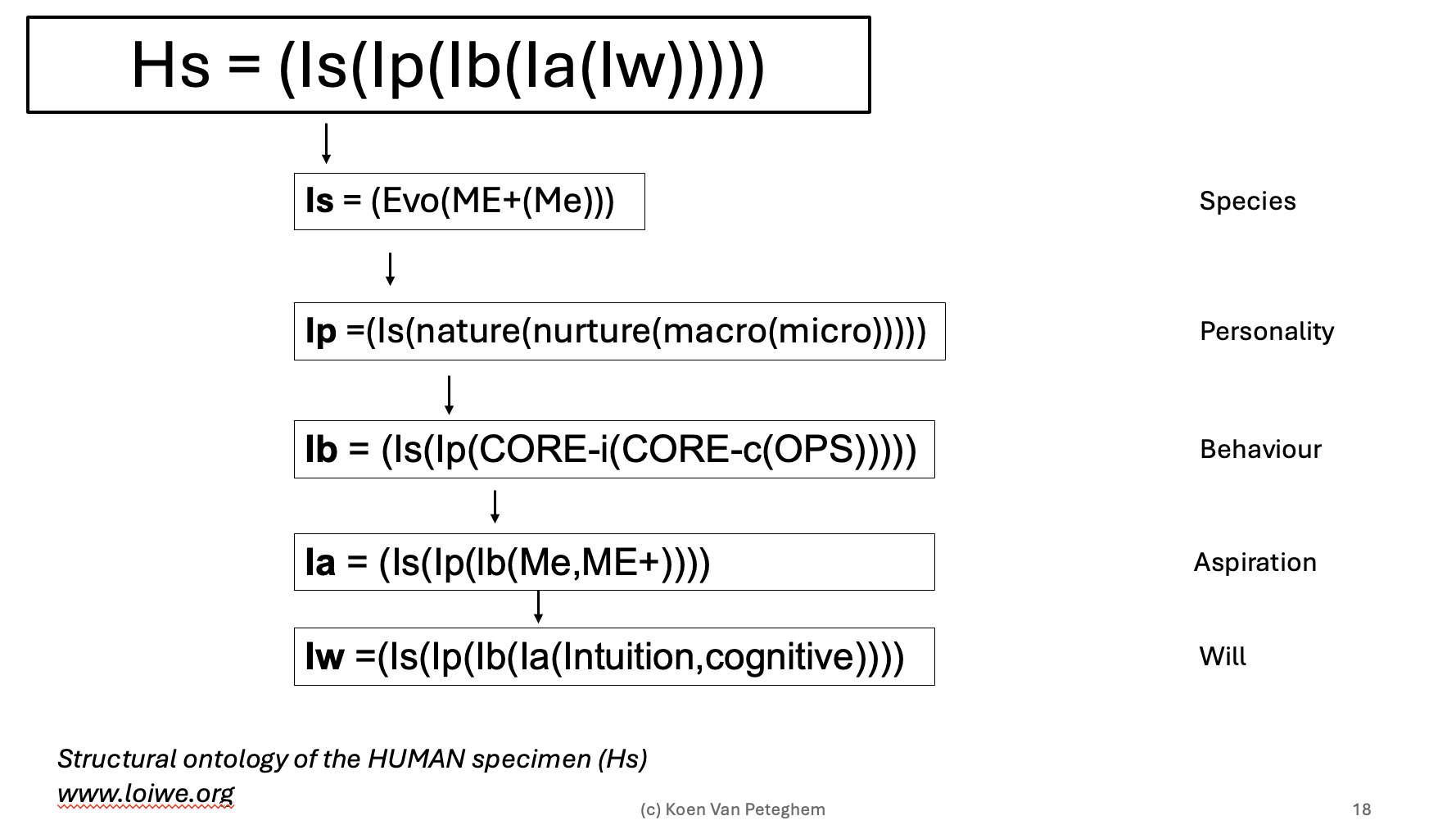
We, all of us, are all of this. All the time.
HARD-STRUCTURALISM
Ontology of Truth and Being
Hs = (Is(Ip(Ib(Ia(Iw)))
Koen Van Peteghem
Gent, 2026
AUTHOR’S NOTE
These writings did not begin as a philosophical project. It began as a practical unease.
For much of my working life, I have been involved in building things that must hold—systems meant to support human life when conditions are not kind: care structures, technical infrastructures, environments where failure is not theoretical. In such places, one learns quickly that reality is not impressed by intention. If a structure rests on a mistaken assumption, it does not protest. It simply gives way.
Over time, that lesson began to echo beyond the technical domain. The unease was not with any single crisis, but with their accumulation. Social fragmentation, exhaustion, loss of meaning, an inflation of choice alongside a contraction of agency—these appeared less as isolated failures than as symptoms. Something more basic seemed to be under strain.
The question slowly shifted. Not what are we doing wrong, but what are we assuming to be true about the human being when we design our institutions, our technologies, and our moral vocabularies?
This work is the result of pursuing that question in a deliberately narrow way. Rather than adding another interpretation of the self, it proceeds by subtraction. Every claim about the human is treated as provisional until its removal renders thought, action, or responsibility unintelligible. What cannot be denied without collapse is retained. What can be denied, however cherished, is set aside.
What remains is not a portrait, but a structure.
The book is organised in three movements. First, a criterion of truth, grounded not in consensus or conviction, but in what a serious life cannot evade. Second, an account of the human being as a layered and nested entity, shaped by body, belonging, and time. Third, the consequences of that structure: the minimal conditions under which human dignity can be sustained rather than eroded.
The tone of what follows is spare by intention. This is not because the subject lacks depth, but because precision matters more than consolation. When the ground is uncertain, clarity is a form of care.
I do not ask the reader to agree. I ask only that they read seriously. Test what is written here by trying to do without it. If the structure can be abandoned without cost, then it does not belong. If it cannot, then something has been named.
The rest is for the chapters themselves.
Koen Van Peteghem
Gent, Belgium, 2026
PART 0. THE BRACKETING GRAMMAR
CHAPTER 0: THE BRACKETING GRAMMAR
0.1 The Necessity of a Visual Grammar
This document specifies the notational system of the structural ontology. The system addresses a primary limitation of linear language: its inability to represent systems of simultaneous, nested co-dependency. The central diagnostic error corrected by this ontology—the Category Error of Sovereignty—is a direct artifact of this limitation, which presents the "I" as a discrete and primary unit.
The bracketing system is not a set of mathematical formulas. It is a visual grammar and a structural map. Its function is to impose a discipline on thought by making explicit the load-bearing architecture of the human being as a nested system. Its symbols encode constraints and conditions of failure. Understanding this grammar is the prerequisite for all subsequent analysis.
0.2 The Parenthesis (): The Grammar of Containment
The parenthesis, (), denotes a bracket of containment. An element enclosed within parentheses is structurally dependent upon, and contained by, the layer immediately outside it. The relationship is one of nesting and emergence.
The foundational expression for Identity is:
Is = (Evo(ME+(Me)))
The grammar is read from the inside out:
· (Me): The aware unit, the biological locus of experience. Its containment specifies that it is a component, not a self-sufficient entity.
· (ME+(Me)): The (Me) is contained within the (ME+), the collective field providing language, recognition, and coordination. The (Me) does not generate these capacities; it operates through them.
· (Evo(ME+(Me))): The entire individual-collective structure is contained within (Evo), the temporal vector of change. The system is therefore non-static and continuously subjected to transformation.
Identity (Is) is the emergent property of this nested structure.
The operational condition is strict:
removal or denial of any containing bracket produces persistent error in the inner layer that cannot be resolved through internal correction. This initiates Structural Debt and, if sustained, leads to breakdown. The parenthesis therefore encodes non-deniable dependency.
0.3 The Comma (,): The Grammar of Polarity
The comma, ,, denotes a non-hierarchical relationship between co-dependent poles that jointly generate a functional field. Where parentheses define containment, the comma defines polarity.
The primary referent is:
Ia = (Asp(ME+, Me))
The notation (ME+, Me) specifies that Aspiration (Asp) is generated by the gradient between two poles:
· Me: individual integrity
· ME+: collective contribution
The field exists only in the tension between these poles. It is not reducible to either.
Operational condition:
removal of either pole eliminates the gradient required for directed action. The system loses orientation and the capacity for purposeful behavior. The comma encodes this dependency on dual-pole structure.
0.4 Formal Rules of the Bracketing Grammar
The grammar is a constraint system governed by three rules. Each rule defines a condition under which the system fails.
Rule 1: Dependency Rule
If A(B), then B cannot maintain functional integrity independently of A.
Operational Test:
If A is removed or denied, B produces persistent error that cannot be reduced through internal correction. The dependency is structural.
Rule 2: Polarity Rule
If (A, B), then the operative field requires both poles.
Operational Test:
If A or B is removed, the gradient required for directed action is eliminated. The system loses orientation and its capacity for coordinated behavior terminates.
Rule 3: Reduction Test
A bracketed structure is valid only if removal of an outer layer produces correction failure in the inner layer.
0.5 The Technical Definition of Collapse: Structural Debt and Systemic Bankruptcy
The phrase “cannot be denied without collapse” is a technical statement. Collapse does not refer to an instantaneous cessation of function. It denotes the terminal condition of a process.
This ontology defines collapse as:
the state in which error can no longer be reduced through correction within available capacity.
Collapse is not an event but the endpoint of a progressive trajectory driven by the accumulation of Structural Debt.
The denial of a Core constraint generates Structural Debt: the accumulated mismatch between the agent’s internal map and the constraints of the system in which it operates. The system must expend capacity to manage this mismatch.
This produces a spectrum of states:
Cost
Error is generated but successfully reduced through correction. The system remains viable, though at increased maintenance load.Damage
Error persists despite repeated correction attempts. The system’s capacity for effective correction begins to degrade.
Structural Debt is not neutral. Whether internalized or externalized, it progressively reduces the agent’s effective capacity to correct. This reduction occurs in two ways:
Internal degradation: distortion of the internal map and reduced reliability of correction
Relational degradation (ME+): weakening of the agent’s position within the collective field, reducing access to distributed correction and coordination
Collapse is reached through a sequence of system states:
Error Generation
A mismatch arises between the agent’s internal map and the constraints of its environment.Cost
Error is detected and reduced through correction. The system remains functional.Damage
Error persists. Correction becomes less effective. Structural Debt accumulates.Degradation
Correction becomes unreliable or inefficient. Errors accumulate faster than they can be resolved.Regression
The system simplifies under strain, losing higher-order functions:
discursive (coherence)
agential (effective action)
existential (orientation)
Collapse
The system reaches a threshold where error can no longer be reduced within available capacity. Functional integrity is lost.
Collapse constitutes Systemic Bankruptcy. The agent can no longer maintain itself as a functioning entity.
This loss may manifest in one or more core capacities:
Logical: loss of coherence (triviality, contradiction)
Practical: loss of effective action (systematic failure in praxis)
Existential: loss of orientation (paralysis, disintegration of the subject)
Collapse is therefore defined functionally, not physically. An agent may persist biologically while having collapsed at one or more structural layers.
Collapse is not binary at the system level. It may occur in one stratum while others remain temporarily operational.
The trajectory toward collapse may unfold in two primary ways:
Gradual erosion: sustained accumulation of Structural Debt progressively depletes correction capacity
Abrupt failure: external pressure exceeds the remaining capacity of a debt-weakened system
In both cases, the underlying mechanism is identical: persistent error combined with insufficient correction capacity.
The statement “cannot be denied without collapse” must therefore be understood in its full technical sense:
Denial of a Core constraint does not necessarily produce immediate failure. It initiates a trajectory in which Structural Debt accumulates, correction capacity degrades, and the system moves toward non-recoverable breakdown.
This trajectory may be delayed, distributed, or partially masked—particularly in buffered or subsidized environments—but it cannot be eliminated.
Collapse is the structural terminus of sustained denial.
0.6 Conclusion: The Diagnostic Utility of the Grammar
The bracketing system provides structural clarity. It is a diagnostic instrument that exposes both organization and failure conditions.
It replaces the model of the sovereign individual with a nested, constrained system. It provides the mechanism for distinguishing between Core (load-bearing constraints) and Penumbra (optional structures).
The grammar does not prescribe action. It defines the conditions under which action remains possible.
It provides the map of what holds.
PART I. Truth as Tribunal
CHAPTER 1: THE SPECIMEN (Definition of the Serious Agent)
1.1 The Necessity of Indexing: Truth as Functional Integrity
In any rigorous foundational enterprise, the primary challenge is to identify a stable observer. Traditional philosophy often fails by attempting to locate truth as a floating absolute—a "God’s-eye view" detached from the requirements of the entity perceiving it. In this work, truth is treated not as a metaphysical prize, but as a functional status. It is a property of the relationship between a claim and the structural integrity of the system that holds it.
A claim is structurally "true" if its denial leads to the collapse of the system that attempts to inhabit that denial. However, "collapse" is not a universal metric. A structural failure in a simple mechanical system differs fundamentally from a failure in a complex biological or social system. Therefore, before we can determine what is "true," we must define the specific entity being tested. We must describe the Specimen whose breakdown serves as the functional proof of truth.
We call this specimen the Serious Agent.
The Serious Agent is the measuring stick of this work. We do not evaluate truth against an abstract ideal or a neutral data processor that exists in a vacuum. We evaluate it against an entity that must reason, act, and maintain its own existence within a world of consequence. The Serious Agent is a "consequence-sensitive navigator." If a claim is such that its denial results in the structural failure of this specific specimen, that claim earns the status of a "Core Truth." The validity of our ontology depends entirely on the rigorous definition of this specimen.
1.2 The Discursive Capacity: The Requirement of Non-Triviality
The first structural property of the specimen is its Discursive Capacity. To function, the agent must be a coherent source and recipient of information. This is a matter of structural integrity in communication and thought.
The agent participates in what is technically termed "the game of giving and asking for reasons." To be an agent—as opposed to a mere object responding to physical force—the specimen must be able to take a "position." It must be able to distinguish "This" from "That." This capacity is governed by the requirement of non-triviality.
For a position to be a "position," it must exclude its opposite. If an entity asserts a claim and its exact negation simultaneously, it ceases to provide information to itself or to others. In formal logic, this is known as "The Principle of Explosion": if one allows a contradiction into a system, everything follows, and the distinction between valid and invalid moves vanishes.
A serious agent is one who recognizes the systemic cost of this logical triviality. Logic is not an optional aesthetic choice or a cultural preference; it is a functional prerequisite for having a mind at all. If the distinction between "yes" and "no" is removed, the agent’s internal and external guidance systems fail. The agent is removed from the game of reasons as a "failed component." To be a serious agent, the specimen must maintain the structural machinery of exclusion. Without it, the agent becomes "noise."
1.3 The Agential Capacity: Consequence-Sensitivity and Praxis
The second property of the specimen is its Agential Capacity. The agent is an entity that operates through Praxis—purposeful action within a field of resistance.
The serious agent is characterized by consequence-sensitivity. It tracks the "Resistance of the World." Unlike a dreamer or an unserious theorist, whose denials of reality carry no immediate penalty, the serious agent has "skin in the game." Every action taken has a predictable result, and the agent must track these results to maintain its structural integrity.
This tracking is a biological and operational necessity. Action is not merely movement; it is movement with an expected outcome. When the agent acts, it is "sampling" reality. If the agent acts on a map that claims a wall is a door, the world provides "Resistance." The serious agent is an entity that is structurally programmed to prioritize this resistance over its internal preferences.
To be a serious agent, the specimen must be capable of Action-Repair. If it repeatedly encounters resistance—if its actions fail to produce the expected outcome—it must be structurally capable of revising its internal map. An entity that continues to act as if a wall were a door, despite repeated failure, is no longer an agent; it is a malfunctioning biological unit. Truth, at this level, is the alignment of the agent's internal map with the external path of resistance. The serious agent is the one who accepts that the "Path" has the final say over the "Map."
1.4 The Existential Capacity: The Subject as a Weighted Entity
The third property is the Existential Capacity. The agent is not a neutral data-processor; it is a Weighted Subject. This means the agent exists in a state where things "matter."
In technical terms, the agent requires an orientation in value to remain viable as a subject. To act, the agent must choose. To choose, the agent must rank. To rank, the agent must possess a hierarchy of "better" and "worse." This ranking is not a "choice" the agent makes; it is a structural requirement of the machinery of deliberation.
If this hierarchy is removed—if the agent genuinely denies that any state is preferable to any other—it enters a state of Structural Paralysis. Denial of value does not result in "objectivity"; it results in the inability to project oneself into any future state.
The serious agent recognizes that "mattering" is a structural prerequisite. Orientation in value is the "horizon" that allows the subject to maintain a coherent self over time. Without this orientation (this "Why"), the subject’s capacity to choose—and thus its capacity to act—disintegrates. The existential layer of our tribunal identifies those truths that prevent this subjective disintegration. A serious agent is one who understands that if "nothing matters," then "nothing is possible."
1.5 The Temporal Project: Flux and the Friction of Change
The serious agent is not a momentary flash of consciousness; it is an entity extended through time. In this ontology, time is not defined as a linear count of seconds, but as Flux—the relentless friction of change.
The agent’s existence is a project of maintaining a stable structure while being carried by this current of change. The agent is a "temporally extended project." The impact of flux on the agent is measured by four technical metrics that define the "Stress of Evo":
Velocity (Speed of Change): This is the frequency of transformations occurring in the agent’s world. It is the rate at which variables—technological, social, or biological—are updated. High velocity requires higher "Operational Bandwidth." If the velocity of change exceeds the agent’s capacity to process it, the agent experiences "vertigo"—a loss of structural orientation.
Acceleration (Rate of Change Increase): This is the speed at which the velocity of change is itself increasing. Acceleration is the primary driver of modern systemic unsteadiness. It forces the agent into a state of permanent "red-lining," where the time available to "patch" its internal map is constantly shrinking.
Breadth (Complexity of Change): This refers to the number of concurrent factors undergoing transformation. A change in a single variable is a low-breadth stressor. A simultaneous shift in economic rules, social norms, family structures, and physical safety is a high-breadth stressor. High breadth threatens the agent’s ability to maintain a coherent "WE."
Depth (Significance of Change): This is the measure of which strata are being hit by the flux. Shallow change affects the optional, "penumbral" layers of life (e.g., fashion, taste). Deep change hits the load-bearing pillars of the structure (e.g., the sanctity of life, the shared meaning of words).
The serious agent recognizes that survival in a high-velocity, high-depth environment requires Structural Weight. It must identify those elements of itself that are "Core"—the elements that do not move even when the environment accelerates. The agent seeks "Bedrock" because it knows that in a storm, only the bound structure holds.
1.6 The Parasitic Nature of the Unserious Environment
While the Serious Agent is the primary truth-sensor, we must technically account for the existence of the Unserious Specimen. The ability of an entity to persist in a state of structural denial—denying logic, resistance, or meaning—does not constitute a counter-example to the ontology. Rather, it identifies a Systemic Parasitism.
An Unserious Specimen can only inhabit a false map because the Structural Debt incurred by its denial is being subsidized by an external Serious Agent.
The Structural Subsidy: In a "padded" environment (e.g., a high-wealth welfare state, a protective family unit, or a stable infrastructure), the immediate self-damage of denial is absorbed by the surrounding nest.
The Mechanism of Parasitism: The Unserious Specimen externalizes its maintenance costs. It denies the "Floor" while standing on a floor maintained by others.
The Limit of Parasitism: This state is contingent and fragile. When the subsidy is removed—or when the environmental acceleration (Evo) exceeds the subsidy’s capacity to absorb debt—the Unserious Specimen experiences a Catastrophic Crash.
The structural ontology remains universal for any entity that must provide its own maintenance. The "Unserious" are technically defined as Non-Self-Sustaining Components that provide no validation data for the floor.
1.7 The Criterion of Self-Damage: The Systemic Red Light
How does the specimen identify a structural error? Through the Criterion of Self-Damage.
In a structural ontology, we do not prove a truth by appeal to popularity, elegance, or tradition. We identify truth by the Red Light of Systemic Breakdown. If a serious agent attempts to deny a core truth, the system itself signals the failure through three distinct modes of self-damage:
Logical Self-Damage (Triviality): The machinery of thought breaks down. The agent becomes "noise." It can no longer differentiate its position from any other. Its discursive capacity is terminated.
Practical Self-Damage (Action Failure): The machinery of navigation breaks down. The agent "hits the wall." It systematically fails to achieve its aims or maintain its physical integrity. Its agential capacity is terminated.
Existential Self-Damage (Disintegration): The machinery of the self breaks down. The subject loses its orientation. It slides into paralysis, bad faith, or pathology. Its existential capacity is terminated.
Self-damage is the functional proof of truth. If the agent can walk away from a claim without experiencing these three failure modes, then that claim is Penumbral (optional). It is a "nice to have," but it is not a load-bearing wall. However, if the denial causes self-damage, the claim is Core (necessary). The Core Inventory is the list of those claims that the Serious Agent must track to remain an integrated, functioning entity.
1.8 The Information-Action Loop: The Architecture of Feedback
To understand why the Serious Agent is the only valid observer of truth, we must analyze its internal mechanics as a Feedback-Driven System. An agent does not merely exist; it operates within a continuous loop of sampling, prediction, and correction. This is the Information-Action Loop.
In technical terms, the agent functions as a "Bayesian Navigator." It holds an internal "Map" of reality (its beliefs and expectations). When it acts (Praxis), it generates an output into the world. The world, being a field of resistance, provides an input back to the agent.
Alignment: If the input matches the internal map, the structure is stable.
Dissonance: If the input contradicts the map (e.g., the wall does not move), the agent receives a "Prediction Error."
The Serious Agent is defined by its commitment to Error-Minimization. Because the agent has "skin in the game," it cannot afford to ignore prediction errors. In a high-consequence environment, a sustained prediction error—acting as if a false claim were true—leads to the accumulation of "Structural Debt."
Structural Debt is the measure of the gap between the agent’s internal map and the floor of reality. If the debt becomes too high, the agent’s capacity to navigate is bankrupt. This is the technical definition of Breakdown. Therefore, the serious agent is structurally compelled to seek out the "Condensed Centre" of truth, as it is the only information set that yields zero structural debt over time. The "Unserious Specimen" is simply an entity that has found a way to externalize its structural debt onto a third party (the family, the state, or the insurance system), allowing it to inhabit a false map without immediate collapse.
1.9 The Maintenance Requirement: Entropy and the Cost of Being
A second critical factor in the specification of the Serious Agent is Entropy. In physics, any organized structure requires a constant input of energy to prevent decay. The Agent is no exception. It is a "Dissipative Structure" that must maintain its internal order in the face of the relentless friction of change (Flux).
Being an agent carries a Maintenance Cost. This cost is paid in "Operational Bandwidth"—the cognitive and physical energy required to keep the three capacities (Discursive, Agential, Existential) running.
Logical Maintenance: The energy required to resolve contradictions and keep thoughts coherent.
Practical Maintenance: The energy required to acquire resources and avoid physical harm.
Existential Maintenance: The energy required to sustain a "Why"—a reason to continue the project.
As the Velocity and Acceleration of change increase, the maintenance cost rises. If the agent is unmoored—if it does not know where the "Floor" is—it wastes vast amounts of bandwidth on "Penumbral Maintenance." It tries to maintain optional, decorative identities or narratives that are constantly being shredded by the current of change.
This leads to Agential Exhaustion. When the maintenance cost exceeds the agent’s bandwidth, the structure begins to simplify. It drops the existential layer first (despair), then the agential layer (passivity), and finally the discursive layer (incoherence).
The finding of this ontology is that Structural Clarity reduces Maintenance Costs. By identifying the "Core Inventory" (the non-deniable truths), the agent can stop wasting bandwidth on the optional and focus entirely on maintaining the load-bearing pillars. This is the "Added Value" of the floor: it is an energy-saving device for the serious agent.
1.10 The Boundary Problem: Where the Agent Ends
Finally, we must specify the Agential Boundary. While later chapters will define the "Nesting" of the self, at the baseline level, we must define where the specimen ends and the "Resistance" begins.
The boundary of the Serious Agent is not the skin. It is the Horizon of Consequence.
If an entrepreneur’s project (like the ETF Mining Truck) fails because of a flaw in the physics of the design, the "Self-Damage" is felt by the entrepreneur. The project is an extension of the agent’s agential capacity. Therefore, the "specimen" we are testing includes the tools, systems, and relationships that the agent requires to fulfill its temporal project.
This means that "Truth" is not just "internal" or "external." It is the Integrity of the Interface between the agent and its world. If the interface is broken—if the agent cannot communicate with others or predict the effects of its tools—the agent is "Fractured."
1.11 Conclusion: The Prerequisite of the Map
We have now provided a complete functional specification of the Serious Agent.
It is a Discursive Entity requiring non-triviality.
It is an Agential Entity requiring consequence-sensitivity.
It is an Existential Entity requiring value-orientation.
It is a Temporal Entity operating under the metrics of velocity, acceleration, breadth, and depth.
It is a Feedback-Driven System that must minimize structural debt.
It is a Limited-Bandwidth System that must minimize maintenance costs.
This specimen is the only entity capable of validating the Meta-Ontology of Truth. Why? Because it is the only entity for whom the "Floor" is a survival requirement.
We have established the "Who." We now move to Chapter 2 to establish the "How." We move from the Specimen to the Criterion of Truth. We are going to define exactly how we will use the Serious Agent as a "Sensor" to detect the bedrock of human existence through the Subtractive Method and the Zone of Impossible Deniability.
CHAPTER 2: THE CRITERION (Meta-Ontology of Truth)
2.1 Truth as Long-Term Structural Sustainability
To prevent the reduction of truth to short-term utility or momentary "success," truth is technically defined as Long-Term Structural Sustainability.
A claim is not true because it "works" for a moment. It is true because it is the only information set that yields Zero Structural Debt over the entire duration of the temporal project (Evo).
The Amortization of Debt: In the short term, an agent may inhabit a lie or an error with apparent success (Practical Viability). However, this success is a form of "Agential Borrowing." The debt accumulates at the structural level.
The Inevitability of Bankruptcy: Systemic bankruptcy occurs when the accumulated debt (the gap between map and bedrock) triggers a terminal failure mode.
Truth is the Inherent Limit of Sustainability. It identifies those constraints that must be tracked if the system is to remain operational indefinitely under the friction of change.
2.2 The Zone of Impossible Deniability: The Topology of Doxastic Cost
The central technical standard of this work is the Zone of Impossible Deniability. To operationalize this standard, we must treat the agent’s field of possible attitudes as a Topology of Cost.
For any substantive claim about the structure of reality or the self, an agent may adopt one of three primary stances: Affirmation, Suspension, or Denial. In non-technical or "unserious" environments, these stances are often treated as having equal agential weight. In a rigorous ontology, however, these stances are ordered by the cost of their inhabitation.
Doxastic Inhabitation Cost: This is the cognitive energy and operational bandwidth required to maintain a specific stance within the discursive capacity.
Structural Integrity Cost: This is the frequency and depth of "Self-Damage" (as defined in 1.6) triggered by the stance during the interaction with the field of resistance (Praxis).
A claim is Penumbral if the cost of its denial is finite and manageable. An agent can deny a penumbral claim—such as a specific economic model or a cultural preference—and continue to function as a reasoning, acting, and viable subject. The denial is "available" for inhabitation.
A claim enters the Zone of Impossible Deniability when the cost of its denial becomes Infinite. This is the limit-position of the topology. "Impossible" does not denote a linguistic or grammatical restriction; it denotes a Structural Barrier. A denial is impossible if its inhabitation leads to the immediate or eventual termination of the agent’s standing as an integrated entity. Truth is the condensed centre of this zone.
2.3 The Condensed Centre: Refinement and Convergence
Truths do not present themselves as core foundations ab initio. They achieve this status through a process of Condensation. This is a technical refinement occurring under the pressure of denial-testing.
As the Subtractive Method is applied to an information set, claims that are contingent, optional, or revisable are stripped away. What remains are the "Limit-Conditions." These claims "condense" toward the centre as they are found to be non-deniable across all three failure modes of the Tribunal (Chapter 3).
The Condensed Centre is the minimal inventory of propositions that satisfy the following technical requirements:
Logical Necessity: The claim must be presupposed for the discursive capacity to function without triviality.
Practical Necessity: The claim must be tracked for the agential capacity to function without action-failure.
Existential Necessity: The claim must be anchored in for the existential capacity to function without subjective disintegration.
Any claim occupying this status is a Core Structural Truth. It represents the functional bedrock of the Serious Agent’s map.
2.4 The Subtractive Method: Formal Rules of Decomposition
To identify the floor of the ontology, we employ the Subtractive Method. This is a formal discipline of radical decomposition. Unlike inductive or deductive methods that seek to "build" truth, the subtractive method seeks to "reveal" truth by the systematic removal of the deniable.
The method is governed by four technical rules:
Rule 1: Structural Isolation.
The candidate proposition must be stripped of all rhetorical, poetic, and penumbral modifiers. It must be reduced to a purely structural assertion concerning the requirements of the Serious Agent.
Rule 2: Denial Simulation.
The agent must perform a simulation of Serious Inhabitation of the negation. The question is not "Can I imagine this being false?" but "What are the systemic consequences if I operate as if this were false?"
Rule 3: Failure Mode Application.
The simulation is processed through the three strata of the Tribunal:
Does the denial result in Inferential Triviality?
Does the denial result in Action-Failure?
Does the denial result in Subjective Disintegration?
Rule 4: Classification.
Claims are classified based on the outcome of the simulation. If a denial can be stably maintained, the claim is relegated to the Penumbra. If the denial triggers a terminal failure, the claim is admitted to the Core Inventory.
2.5 Core vs. Penumbra: The Sorting Device for Necessary Structure
The primary technical output of the Meta-Ontology is the sharp categorical distinction between the Core Inventory and the Penumbral Heuristic.
The Core Inventory (The Floor): This consists of the set of all non-deniable claims. The Core is characterized by Stability and Invariance. It provides the load-bearing requirements that apply to all Serious Agents regardless of their specific specimen configuration. The Core is the definition of "Truth" in the strict sense.
The Penumbral Heuristic (The Decoration): This consists of all deniable claims—narratives, models, scientific theories, and cultural identities. The Penumbra is characterized by Revisability and Optionality. While penumbral claims are necessary for navigating the complexity of specific environments (Macro/Micro), they do not possess the status of truth.
The "Added Value" of this distinction is the elimination of Structural Mis-categorization. Systemic unsteadiness (Identity Confusion) is technically defined as the attempt to anchor a Core requirement in a Penumbral claim. Structural Clarity is the restoration of the hierarchy between the necessary floor and the optional décor.
2.6 Truth as Low-Entropy Information: The Metrics of Efficiency
From the perspective of systems maintenance, the difference between Core Truth and Penumbral Heuristic can be analyzed through Information Entropy.
Maintaining an information set requires Agential Energy.
High-Entropy Information (Penumbra): Because penumbral claims are deniable, they require constant external validation, social consensus, and complex secondary justifications to remain agentially plausible. This results in high Maintenance Costs. The agent must dedicate significant bandwidth to preserving the narrative against the friction of change.
Low-Entropy Information (Core): Core truths are the most compressed and efficient data points possible. They do not require external validation because they describe the hard constraints of the agent-world interface. They have Minimal Description Length relative to their predictive power.
Truth, as the condensed centre, is therefore the state of Maximum Information Efficiency. Identifying the Core Inventory reduces the cognitive load of the Serious Agent. It allows the specimen to let go of the high-maintenance luggage of the penumbra and focus entirely on the low-maintenance necessity of the floor. This reduction in entropy is the technical prerequisite for surviving high-velocity change.
2.7 The Topology of Resistance: Hard vs. Soft Constraints
Why do some claims condense while others remain penumbral? This is determined by the Topology of Resistanceencountered during Praxis.
The world is characterized by a gradient of resistance:
Soft Constraints: These are constraints imposed by the collective field (ME+) that are deniable without immediate systemic collapse (e.g., social etiquette, legal codes, linguistic fashion). These are navigated via the Penumbra.
Hard Constraints: These are constraints imposed by the biological hardware, the laws of logic, and the physics of the environment. Denying a Hard Constraint triggers immediate and terminal Self-Damage. These are the basis of the Core.
Impossible deniability is the agential recognition of a Hard Constraint. When a claim is identified as "True," we are stating that it maps directly onto a Hard Constraint of the specimen’s existence. The Condensed Centre is the region where the Hard Constraints of the Discursive, Agential, and Existential capacities converge.
2.8 Doxastic Energy expenditure: The Cost of Inhabitation
The technical definition of "Impossible" in this ontology relies on the Limit of Agential Bandwidth.
An agent can inhabit a denial of a core truth for a momentary duration (e.g., a flash of irrationality or a poetic exercise). However, the Energy Expenditure required to maintain that denial over time (Evo) increases exponentially as the denial creates more Structural Debt.
The agent must constantly resolve the logical contradictions.
The agent must constantly repair the action-failures.
The agent must constantly suppress the existential anomie.
Eventually, the maintenance cost exceeds the agent’s total available bandwidth. At this point, the structure "Simplifies" or "Crashes." The denial is "Impossible" because no Serious Agent has the infinite energy required to inhabit it indefinitely. Truth is the only state that is Energetically Sustainable for the human structure over the long term.
2.9 Recursive Validity: The Self-Justification of the Criterion
The Meta-Ontology of Truth is not an arbitrary framework; it is Recursively Valid. To deny the criterion (that truth is impossible deniability) is to return to a "soft" definition of truth (truth as preference or consensus).
Running this denial through the Tribunal reveals:
Logical Failure: A "soft" definition of truth cannot distinguish between the necessary and the optional, leading to inferential triviality when structural foundations are questioned.
Practical Failure: An agent using a "soft" definition of truth systematically fails to track Hard Constraints, leading to accumulated Structural Debt and eventually terminal Action-Failure.
Existential Failure: A "soft" floor provides no orientation, leading to Subjective Disintegration in high-acceleration environments.
Therefore, the Criterion itself is a Core Structural Truth. It is the only technical standard that allows the Serious Agent to maintain its integrity over time.
2.10 The Role of the Internal Tribunal
Finally, we must specify the function of the Tribunal. It is not an external judge but an Internal Quality Controlmechanism.
The purpose of the Meta-Ontology is to discipline the agent’s map. It provides the "Application Rule" for all future building:
Identify the foundational claims.
Subject them to the Subtractive Method.
Measure the Failure Modes.
Classify as Core or Penumbra.
This discipline ensures that the agent is not "Floating" on penumbral narratives but is "Anchored" in structural necessity. It is the only method that yields a Map that holds under stress.
2.11 Conclusion: Summary of the Criterion
We have established the technical standard for this treatise.
Truth is Status: Systemic functional integrity.
Standard is Impossible Deniability: Inhabitation resulting in infinite cost.
Tool is the Subtractive Method: Systematic decomposition of the deniable.
Outcome is the Core Inventory: The non-negotiable floor of existence.
We have our Specimen (Chapter 1) and our Standard (Chapter 2). We have identified the metric of truth as Information Efficiency and Structural Sustainability. We are now ready to analyze the Mechanics of Failure in detail.
We move to Chapter 3, where we will specify exactly how the "Red Light" of self-damage manifests across the Logical, Practical, and Existential strata. We will define the failure of the system to find the truth of the system.
CHAPTER 3: THE TRIBUNAL (Mechanics of Denial Failure)
3.1 The Tribunal as Systemic Stress-Testing
The Meta-Ontology of Truth functions as a negative filter within the agential system. It does not attempt to construct a positive world-picture via inductive accumulation or speculative metaphysics. Instead, it identifies the structural floor through the rigorous observation of systemic failure. In this technical framework, the Tribunal serves as the stress-testing laboratory where candidate claims are subjected to the Stress of Denial.
For the Serious Agent, truth is the information residue that remains when all deniable propositions have been eliminated. We identify the boundary of truth by mapping the specific ways in which the system of the Agent breaks down when it attempts to inhabit a denial of its foundational constraints. These breakdown points are categorized into three distinct Failure Modes: Logical, Practical, and Existential. A claim is admitted to the Core Inventory only if its denial triggers a terminal failure across all three operational layers. This three-fold verification ensures that the "Floor" is not merely a linguistic or psychological construct, but a structural necessity.
3.2 The Logical Layer: Information Integrity and the Machinery of Thought
The first layer of the Tribunal concerns the Discursive Capacity of the specimen. At this level, impossibility is internal to the machinery of reasoning. It is a failure of the processing hardware required to hold a position or communicate a stance.
3.2.1 The Mechanism: Performative Self-Defeat
Performative self-defeat is a structural clash between the informational content of a statement and the agential act of stating it. For the Serious Agent, who is bound by the requirement of non-triviality, this is a terminal error.
Presupposition Failure: To articulate a denial of a core logical principle—such as the law of non-contradiction—the Agent must distinguish its position from its opposite. By making this distinction, the Agent is already utilizing the machinery of exclusion. It is "using the floor to argue that the floor is an illusion." This is a technical violation of the discursive contract.
Inferential Triviality: If an Agent genuinely inhabits the denial of logical exclusion (asserting that "A" and "not-A" are simultaneously valid in the same respect), the system enters a state of "Explosion." In formal information theory, this is the point where every possible statement becomes simultaneously true and false. The distinction between "Signal" and "Noise" vanishes.
3.2.2 Systems Analysis: Data Corruption and Search-Space Explosion
From a systems-engineering perspective, Logical failure is a breakdown of Data Compression and Integrity.
Loss of Compression: Core truths (such as non-contradiction or identity) allow the Agent to "compress" reality into a manageable map. They allow the mind to automatically discard an infinite number of "Impossible" scenarios. If contradictions are permitted, the Agent must process all scenarios. The search-space for any decision or inference becomes mathematically infinite.
Agential Latency and Systemic Hang: The processing power of the Agent is consumed by the attempt to resolve the unresolvable. This leads to high Latency—the system "hangs." The Agent cannot finalize a thought or formulate an aim because its internal guidance system is trapped in a recursive loop of self-contradictory static.
3.2.3 The Result: Trivialization
The failure mode at this layer is Trivialization. The Agent does not reach a "freer" way of thinking; it simply ceases to be an informational source. It becomes "Noise" in the collective field. Because the Serious Agent requires a coherent internal map to navigate the world of consequence, logical self-defeat is a terminal failure of the discursive capacity. It is the first "Red Light" of systemic breakdown.
3.3 The Practical Layer: Agential Navigation and the Resistance of Bedrock
The second layer of the Tribunal concerns the Agential Capacity. Here, the standard for impossible deniability is Action-Failure. We move from the internal machinery of thought to the Praxis interface—the interaction between the specimen and the external field of resistance.
3.3.1 The Mechanism: The Resistance of Hard Constraints
The world is not a neutral projection or a fluid narrative; it is a field of Hard Constraints. Practical impossibility occurs when an Agent attempts to inhabit a denial that contradicts these constraints.
Performative Self-Sabotage: This occurs when the Agent’s stated denial is continuously and non-accidentally contradicted by its own biological and operational requirements. An Agent may "say" it denies the reality of physical cause and effect, but it cannot "act" as if causes do not produce effects without immediate and catastrophic physical destruction. The specimen's requirement for energy, oxygen, and structural integrity constitutes a set of "Core" facts that push back with absolute force.
Tracking Error: As a feedback-driven system, the Agent must minimize structural debt. A practical denial creates a permanent and widening gap between the internal map and the path of resistance.
3.3.2 Systems Analysis: Structural Debt and Feedback Lag
In the "Practical Layer," truth is enforced by the Inertia of the World. The world functions as a Finite Resource System.
Structural Debt Accumulation: This is the technical measure of the gap between the agent’s internal map and the floor of reality. If the Agent acts as if a wall is a door, it incurs immediate debt in the form of physical damage. In an "Unserious Environment" (the nursery), this debt can be externalized or muffled by the "Nest." But for the Serious Agent, the debt must be paid.
Agential Crash: Because the Serious Agent is a temporally extended project, it eventually hits the point of bankruptcy. The "Red Light" of Action-Failure is the world’s final refusal to support the Agent's false map. The Agent "hits the wall," and its capacity to achieve aims or maintain its physical integrity is terminated.
3.3.3 The Result: Agential Termination
Practical truth consists of the set of claims that the Agent must track to avoid being destroyed by the resistance of reality. The failure mode here is Collapse. You cannot inhabit a denial of bedrock in a world constructed of bedrock.
3.4 The Existential Layer: Subjective Viability and the Potential Difference
The third and deepest layer of the Tribunal concerns the Existential Capacity. Here, "impossible deniability" refers to the viability of the subject. We ask: "Can the Agent stably inhabit this denial and still remain a recognizable, functioning human self over time?"
3.4.1 The Mechanism: Existential Erosion
The human specimen is a Weighted Subject. It requires a hierarchy of value—a sense of Mattering—to deliberate, choose, and project its structure into a future.
Dissolution of the Why: If an Agent genuinely denies that any state is preferable to any other (the state of radical nihilism), the machinery of agential choice breaks. Without a "Why" (value), there is no basis for a "How" (action). The subject loses its orientation and its "Structural Weight." It begins to drift into disintegration.
Pathological Re-anchoring: Total value-denial is energetically unsustainable for the human structure. Therefore, a system in existential failure often attempts Ad Hoc Repairs. It re-anchors itself in disguised, often destructive forms of meaning—addictions, fanatical ideologies, or obsessive operational routines. The Tribunal recognizes these not as "voluntary choices," but as symptoms of structural failure. The fact that the Agent must re-anchor proves that the original denial was existentially impossible.
3.4.2 Systems Analysis: Agential Energy and the Orientation Gradient
From a technical perspective, the subject is an Energy-Consuming Project.
The Orientation Gradient: To move a limb or process a complex thought requires agential energy. In physics, energy only flows when there is a potential difference. In ontology, agential energy only flows when there is a Gradient of Mattering—a distinction between "where I am" and "where I must be." If an Agent genuinely denies value, it flattens the landscape. It removes the gradient.
Systemic Shutdown: Without a gradient of mattering, the subject becomes a "Dead System." It retains the hardware of an agent but possesses no current. This is the technical cause of clinical anhedonia and structural paralysis. The subject ceases to project itself, effectively terminating the temporal project.
3.4.3 The Result: Subjective Disintegration
The failure mode here is Pathology. The subject "shuts down" to conserve energy because it can no longer justify the maintenance cost of its own existence. Existential truth consists of those anchors (Meaning, Connectedness, Value) that allow the subject to remain a viable project.
3.5 Cumulative Verification: The Convergence of Failure
A claim reaches the Condensed Centre of truth only when its denial triggers a terminal failure across all three layers. This is the technical process of Cumulative Verification. It provides a "Wall of Certainty" that no single-layer test can achieve.
To analyze a claim using the Tribunal, one must run the following Simulation of Failure:
Isolation: Take the claim (e.g., "The human is a nested structure").
Denial: Inhabit the negation ("The human is a sovereign individual").
Stress Test:
Logic: Does the denial require using the very connectedness it denies (e.g., using shared language to assert independence)? Yes. (Logical Failure).
Praxis: Does the denial lead to uncoordinated action and systematic tracking errors in a world of others? Yes.(Practical Failure).
Existence: Does the denial lead to the "Burnout of the Self" and a loss of orientation anchors? Yes.(Existential Failure).
The convergence of failure across the Logical, Practical, and Existential strata creates a Structural Barrier. Truth is the technical description of that barrier. It is the "Bedrock" because there is nowhere else for the Agent to go without experiencing systemic self-damage.
3.6 Diagnostic Utility: Sorting and Debugging the Map
For the Serious Agent, the Added Value of the tri-layered Tribunal is Diagnostic Utility. In a world defined by high-velocity change and "Identity Confusion," the Agent must be able to "debug" its internal map with high efficiency.
The Tribunal provides a sorting mechanism for all information:
Penumbral Claims (Optional/Heuristic): These are claims for which denial is available at one or more layers without terminal collapse. For example, a specific cultural tradition may be practically inefficient but existentially anchoring. It remains in the Penumbra as a "Revisable Heuristic."
Core Truths (Necessary/Floor): These are the "Must-Tracks." They have been validated by the three-fold failure of their denial. They are the only data points that yield zero structural debt over the duration of the project.
By applying the Subtractive Method through this Tribunal, the Agent identifies its Minimum Viable Structure. It identifies the "Load-Bearing Pillars" of its existence. This clarity allows the Agent to stop wasting bandwidth on Penumbral Maintenance—the exhausting attempt to uphold optional or false identities—and focus entirely on the maintenance of the floor.
3.7 Technical Specification of "Self-Damage"
To conclude the mechanics of the Tribunal, we must specify the metric of Self-Damage. Self-damage is the functional signal that the Agent has attempted to walk through a Core Constraint. It is the "Feedback" from the floor.
Type A: Dissipation. The loss of agential energy (Existential).
Type B: Disruption. The loss of agential coordination (Practical).
Type C: Distortion. The loss of agential coherence (Logical).
A claim is "True" if its denial triggers one or more of these signals in a non-recoverable way. The Core Inventory is the map of those constraints which, if ignored, lead to the "Bankruptcy" of the Serious Agent.
3.8 Conclusion: The Threshold of Substantive Ontology
We have now completed the technical specification of the Meta-Ontology of Truth.
We have defined the Specimen (The Serious Agent).
We have established the Criterion (Impossible Deniability).
We have detailed the Tribunal Mechanics (Logical, Practical, and Existential failure modes).
The "Testing Equipment" is now fully calibrated. We are no longer operating in the realm of opinion, consensus, or "soft" truth. We have a rigorous, subtractive method for identifying the non-negotiable floor of human existence.
We are now ready to apply this technical apparatus to the human being. We move from "How we know" to "What we are." In the next chapter, we will use the Tribunal to perform the first radical subtraction. We will dismantle the "Category Error" of the sovereign individual and prove that the human being is, by structural necessity, a Nested Entity. We move to the Deconstruction of Sovereignty.
CHAPTER 4: THE CORE FINDING (Deconstruction of Sovereignty)
4.1 The Category Error: Structural Analysis of the "Species of One" Fallacy
The primary finding of this structural ontology is the identification of a fundamental misclassification in the modern agential map. This error is designated as the Category Error of Sovereignty, or the myth of the "Species of One."
In technical terms, a category error occurs when a property belonging to a specific structural level is erroneously attributed to a sub-component of that level. In the case of the human being, the error consists of mistaking the Biological Aware Unit (the individual specimen) for a Sovereign Metaphysical System (the self-sufficient individual). Modern culture treats the human specimen as if it were a "Species of One"—an entity capable of generating its own logic, defining its own meaning, and maintaining its own structural integrity in isolation from external brackets.
From a systems-engineering perspective, this is a terminal diagnostic error. No complex component can be understood or operated outside of its specific Operating Environment. To analyze an aware unit as a sovereign entity is as structurally incoherent as analyzing a single transistor without reference to the circuit, or a single lung without reference to the atmosphere. Sovereignty is not a "liberation" of the component; it is the Decoupling of the component from the inputs and constraints required for its functionality.
The "Species of One" model assumes that the “Is” is a primary, internal reality and that the "WE" (the collective) and "EVO" (the temporal current) are secondary, optional attachments. The structural ontology reverses this hierarchy. It posits that the “Is” is an Emergent Property of a nested system. Attempting to inhabit the "Species of One" model triggers the three failure modes of the Tribunal because it forces the specimen to operate in a vacuum where the necessary informational and agential inputs are missing.
4.2 The Necessity of Nesting: Technical Proof of the Plural Self
To move beyond the category error, we must establish the Necessity of Nesting. Nesting is defined as the structural arrangement where a component is contained within, and dependent upon, a larger field of operation. For the Serious Agent, nesting is not a social preference; it is an Ontological Constraint.
We prove this by subjecting the denial of nesting—the claim of absolute sovereignty—to the tri-layered Tribunal specified in Chapter 3.
4.2.1 Logical Failure: The Presupposition of the Field
The claim "I am a sovereign individual" is a Performative Self-Defeat.
Informational Input: To formulate the concept of “Is” or "Sovereignty," the specimen must utilize a linguistic and logical codebase.
External Source: The specimen did not invent this codebase; it was acquired from the collective field.
Contradiction: The act of asserting independence requires the use of the very "Connectedness" it seeks to deny. To speak or think "Sovereignty" is to demonstrate "Nesting."
Logically, the aware unit cannot distinguish itself as an “Is” without the prior existence of a "Not-I" (the field). Sovereignty is a Logical Fracture because it attempts to maintain a distinction (the self) while denying the boundary (the relationship to the other) that makes the distinction possible.
4.2.2 Practical Failure: Agential Coordination and Resource Acquisition
In the layer of Praxis, the "Species of One" triggers immediate Action-Failure.
Tracking Error: A sovereign agent operates on a map that ignores the requirements of the "WE." However, the field of resistance is occupied by other agents.
Coordination Collapse: Survival, trade, and safety—the prerequisites for the maintenance of the biological specimen—require high-fidelity coordination with the collective field.
Systemic Bankruptcy: An agent who genuinely acts as if it is sovereign fails to track the social and environmental feedback required for navigation. The result is an accumulation of Structural Debt that leads to the termination of agency.
Practically, the specimen acts as a nested entity even when it speaks as a sovereign one. The denial of nesting is Practically Unsustainable because the aware unit lacks the "Operational Bandwidth" to fulfill its own requirements in total isolation.
4.2.3 Existential Failure: The Erosion of the Subjective Project
At the deepest level, sovereignty leads to Subjective Disintegration.
The Recognition Requirement: As established in the specification of the Serious Agent (Chapter 1), the subject requires an orientation in value to remain viable. Orientation is a Positional Property—it requires a "Nest" to provide the coordinates of "better" and "worse."
Anomie and Burnout: When meaning is moved entirely "inside" the sovereign individual, the "Orientation Gradient" (3.4.2) flattens. The subject enters a state of Structural Anomie, where every action feels arbitrary.
Pathology: The "Species of One" error forces the specimen to become the sole maintainer of its own "Why." This leads to the literal exhaustion of the agential energy. The subject "shuts down" (Depression/Paralysis) because the cost of maintaining a sovereign floor exceeds its biological bandwidth.
Result of the Proof: The nesting of the aware unit within a collective and temporal field is a Core Structural Truth. Its denial results in Trivialization, Collapse, and Disintegration. The "Species of One" is not a version of the human being; it is a description of the human being in a state of terminal failure.
4.3 Relocation: Identity as an External Structural Fact
The deconstruction of sovereignty necessitates the Relocation of Identity. In the "Species of One" model, identity is viewed as an internal psychological state—a "soul" or a "self" contained within the biological specimen. In the structural ontology, identity is redefined as an External Structural Fact.
4.3.1 Identity as Tension
Identity is not the "Center Point" of the specimen; it is the Quality of the Tension between the brackets of the system. It is a positional status. You do not have an identity; you occupy a position within a nested hierarchy of forces.
This shift moves identity from the realm of "Feeling" (Penumbra) to the realm of "Positioning" (Core).
Internal Identity: Fragile, high-entropy, requiring constant self-expression to remain plausible.
Structural Identity: Stable, low-entropy, anchored in the non-deniable facts of biological hardware, collective software, and temporal flux.
4.3.2 The Function of the Bracket
The “Is” is technically defined as the interface between the Aware Unit and its operating environment. To understand the "Is," the Serious Agent must look outward at the brackets that contain it.
The First Bracket (ME+): The collective field that provides the code (Language), the recognition (Social Status), and the safety (The Nest).
The Second Bracket (EVO): The temporal vector that provides the momentum (History) and the search-space (Future Possibilities).
Relocating identity to these brackets provides the agent with Structural Weight. It prevents the "drift" and "vertigo" of modern individualism by acknowledging that the floor of the self is located in the Connectedness of the system, not in the autonomy of the component.
4.4 The Finding: The Human Being as a Composite Structure
The core finding of this chapter is that the human being is a Composite Structure, not a singular entity.
A composite structure is one whose properties are determined by the interaction of its parts. If you remove the "Nesting," the properties of the human being—Agency, Meaning, Reason—disappear. Therefore, any account of the human that begins with the "Individual" is starting with a De-structured Component.
This finding mandates a new "Application Rule" for the chapters that follow:
We shall not analyze traits; we shall analyze Strata.
We shall not search for "Who am I?" until we have mapped "What am I?".
We shall treat the "Me" as a Variable and the "Nesting" as a Constant.
4.5 Conclusion: The End of Sovereignty
We have completed the technical deconstruction of the "Species of One." We have proven, through the mechanics of the Tribunal, that the sovereign individual is a structural impossibility.
The Category Error has been identified: Mistaking the specimen for the system.
The Necessity of Nesting has been proven: Denial leads to terminal systemic failure.
The Relocation of Identity has been established: The “Is” is a positional fact of connectedness.
This is the Core Finding of the work. It provides the "Relief of Soundness"—the realization that the unsteadiness of the modern self is a result of trying to stand on a non-existent sovereign floor.
PART II. Human Being
The Composite Structure of the Human Being
The human being, as established through the Subtractive Method and validated by the Tribunal, is not a singular entity but a nested composite structure.
Its full structural representation is:
Hs = (Is(Ip(Ib(Ia(Iw)))))
This notation specifies that the human being (Hs) is composed of five interdependent strata, arranged in a hierarchy of containment.
Is (Identity): the species-level structure of connectedness
Ip (Personality): the architecture of limits of the specimen
Ib (Behavior): the operational patterns of action
Ia (Aspiration): the directional field of purpose
Iw (Will): the point of decision and execution
The structure is not additive. It is not a collection of layers or components.
The human being (Hs) is a constraint-bound system.
Each stratum exists only through its embedding within the others. No layer operates independently, and no layer can be removed without degrading the functional integrity of the system. The relations between strata are governed by the Dependency Rule defined in Chapter 0: removal or distortion of any containing layer produces persistent error in the inner layers that cannot be resolved through internal correction.
The strata are therefore not parts in a container, but positions within a system of constraints. The structure is defined by what cannot be removed without loss of function.
This architecture is fully nested:
Will (Iw) operates only within the field of Aspiration (Ia)
Aspiration (Ia) operates only through Behavior (Ib)
Behavior (Ib) operates within the limits defined by Personality (Ip)
Personality (Ip) is contained within Identity (Is)
The human being is the totality of this nested constraint system.
This structure is not developmental or sequential. All strata are simultaneously active. However, for purposes of analysis, they are presented from outer to inner containment.
The ordering is therefore methodological, not temporal.
This formulation defines the minimum viable structure of the human being. It specifies the set of constraints required for a system to function as a Serious Agent. Any system lacking one or more of these strata, or severing their dependencies, degrades toward loss of coherence, effectiveness, or orientation, as defined in Chapter 0.
The representation Hs = (Is(Ip(Ib(Ia(Iw))))) is therefore not descriptive, but diagnostic. It encodes both structure and failure conditions.
Finally, it must be noted that Hs is not necessarily the ultimate boundary of the system. In accordance with the logic of the bracketing grammar, any bracket may itself be contained within a larger structure. The present work defines Hs as the operational boundary of the human being for purposes of analysis. However, this does not exclude the possibility that Hs itself is embedded within higher-order systems—ecological, civilizational, or otherwise—which impose additional constraints not treated in this volume.
Such extensions do not alter the internal validity of Hs, but expand the field in which it is situated.
We therefore proceed with Hs as the defined system of analysis.
We begin with Stratum I: Identity, the outermost structural layer, which defines the conditions under which all subsequent strata can exist.
CHAPTER 5: STRATUM I – IDENTITY of species (What We Are)
5.1 The Representation of Connectedness: Is = (Evo(ME+(Me)))
The first stratum of the human being is defined as Identity (Is). In this technical framework, identity is not a psychological state or a "soul" existing in isolation. It is a Positional Property of a nested system. Identity answers the first interrogation of the Serious Agent: What am I?
The answer is expressed in the formal structural formula:
Is = (Evo(ME+(Me)))
This representation specifies that Identity is the emergent result of three nested brackets. It identifies the human being not as a point, but as a Dynamic Tension between the aware unit, the collective field, and the temporal vector. To understand the "I," one must analyze the brackets that contain it. In this ontology, identity is not a noun; it is a Verb of Connectedness. It is the ongoing act of a biological unit being programmed by a collective field and swept forward by the friction of change.
5.2 Component Analysis: The Three Brackets of Being
To operationalize the formula, we must provide a functional specification for each of its components.
5.2.1 The (Me): The Aware Unit as Biological Prerequisite
The (Me) is the innermost bracket of the structure. It is technically defined as the Locus of Immediate Experience.
Hardware: The (Me) consists of the biological organism, specifically the nervous system and the sensory apparatus. It is the "Sensor" that detects the resistance of the world.
Function: The (Me) provides the system with a unique "Aperture." It is the point where data is sampled and where agential outputs are initiated.
Structural Constraint: Viewed in isolation, the (Me) is a powerless singularity. It possesses the capacity for awareness but lacks the Code required for identity. Without the outer brackets, the (Me) is merely a feral biological specimen. It is the necessary hardware, but it is not yet a "Human Identity."
5.2.2 The (ME+): The Collective Field as Structural Nest
The second bracket is the (ME+). This is the Operating Environment or the "Nest" in which the (Me) is embedded.
The Intersubjective Code: The (ME+) provides the linguistic, logical, and symbolic codebase required for thought. An “Is” cannot name itself or distinguish itself without a language it did not invent.
Recognition and Status: The (ME+) is a field of other agents. Identity requires Mutual Recognition. The (Me) only becomes an “Is” when it is recognized as a subject by the "WE."
Structural Function: The (ME+) absorbs the "Structural Debt" of the individual (as defined in 1.8). It provides the safety and resources that allow the (Me) to dedicate bandwidth to higher-order functions. To be human is to be ofthe (ME+), not merely connected to it. The (ME+) is the software that programs the hardware of the (Me).
5.2.3 The (Evo): The Temporal Vector and the Friction of Change
The outermost bracket is (Evo). As specified in Section 1.5, (Evo) is not the linear passing of time, but the Relentless Friction of Change.
Vector of Momentum: Both the (Me) and the (ME+) are carried by the current of (Evo). Identity is a Temporal Projection—it is the maintenance of structural stability across the metrics of velocity, acceleration, breadth, and depth.
Refinement Mechanism: (Evo) is the source of the "Stress Tests" that condense truth. It is the force that forces the structure to update its internal map.
Structural Function: Without (Evo), identity would be a static, lifeless snapshot. (Evo) provides the "Current" that makes identity a process. The “Is” is the act of maintaining the tension between the (Me) and the (ME+) while being hit by the flux of change.
5.3 Identity as Property: The Tension Between Brackets
A critical finding of Stratum I is that the “Is” is not located at the center of the formula. The “Is” is the Quality of the Tension between the brackets.
5.3.1 The Emergent Self
In systems engineering, an emergent property is one that a system possesses but its individual parts do not. "Identity" is an emergent property of the nesting.
If you remove the (ME+), the (Me) loses its language and its subject-status.
If you remove (Evo), the system loses its momentum and its ability to refine itself.
If you remove the (Me), the field has no aperture.
The “Is” is technically defined as the Connectedness itself. It is the interface where the biological hardware meets the collective software in the stream of change. This relocation of the self from "inside" to "interface" is the primary corrective to the Category Error of Sovereignty.
5.3.2 The Equilibrium Requirement
For Identity to remain stable, the tension between the brackets must be maintained in Structural Equilibrium.
Individualistic Distortion: When the (Me) attempts to dominate the (ME+), the structure becomes "Lightweight" and fragile. It loses its anchors and is swept away by the acceleration of (Evo).
Collectivist Distortion: When the (ME+) overwhelms the (Me), the aperture is closed. The specimen becomes a mere cell in a hive, losing its discursive and agential capacity as a Serious Agent.
Structural Clarity consists of recognizing that the “Is” is the balance point. You are the act of being bound.
5.4 The Tribunal: Technical Validation of Stratum I
To confirm that Is = (Evo(ME+(Me))) is a Core Structural Truth, we must run the denial of any component through the Tribunal.
5.4.1 Denial of the (ME+) (The Myth of the Feral Sovereign)
Logical Failure: The agent cannot articulate the denial of the collective field without using the language and logic of that field. The act of saying "I don't need the WE" is a performative self-defeat.
Practical Failure: The agent cannot maintain its biological hardware in total isolation. Human survival is a multi-agent coordination task. Total decoupling from the (ME+) leads to terminal action-failure.
Existential Failure: As established in Chapter 3, the subject requires recognition. Sustained isolation leads to the disintegration of the subject (Anomie).
Verdict: The (ME+) is a Non-Deniable Bracket.
5.4.2 Denial of (Evo) (The Myth of the Static Soul)
Logical Failure: To deny change is to deny the machinery of reasoning, which is a process of state-transition. A static mind is an oxymoron.
Practical Failure: An agent who acts as if the world is static fails to track the variables of flux. They accumulate massive structural debt and "hit the wall" of the next transformation.
Existential Failure: A subject without a temporal project has no future into which it can project itself. The result is terminal paralysis.
Verdict: (Evo) is a Non-Deniable Bracket.
5.5 Identity as a Verb: The Duty of Maintenance
Because Identity is a dynamic tension and not a static object, it requires Constant Maintenance. This moves Identity from the realm of "Possession" to the realm of Operational Task.
5.5.1 The Maintenance of Connectedness
The Serious Agent does not "have" an identity; it fulfills an identity. Fulfillment is the technical term for keeping the brackets aligned.
Maintenance of the (Me) involves biological stewardship (Health/Integrity).
Maintenance of the (ME+) involves social stewardship (Covenant/Obligation).
Maintenance of (Evo) involves historical stewardship (Heritage/Future-Orientation).
5.5.2 Structural Integrity vs. Expressive Identity
Modern culture prioritizes Expressive Identity—the attempt to make the "Penumbra" (tastes, feelings) look like the "Core." This is an inefficient use of bandwidth.
Structural Ontology prioritizes Structural Integrity—the maintenance of the load-bearing connectedness. When the connectedness is sound, the "feelings" of identity take care of themselves. "Identity Confusion" is technically diagnosed as a Maintenance Failure of the brackets.
5.6 Information Theory of the "Is": Minimal Description Length
From the perspective of Chapter 2 (Information Efficiency), the representation
Is = (Evo(ME+(Me))) is the most efficient description of a human being at species level
Penumbral Descriptions: Describing a human through their traits, history, and preferences requires a "High-Entropy" data set (millions of variables).
Structural Description: Describing a human through the nesting representation is "Low-Entropy." It identifies the Invariants of the system.
A Serious Agent who anchors in this representation reduces their cognitive maintenance cost. They no longer need to "manufacture" a self through constant self-expression. They recognize that their "What" is already settled by the structure of the brackets. This frees up the "Tip of the Iceberg" (Will) to focus on agential navigation rather than metaphysical construction.
5.7 The Specificity of the Interface to the Human
We must specify why this representation is specific to the human specimen. Other biological organisms are nested in environments and carried by time, but the human is the only agent that perceives the brackets.
The "Specialness" of the human being is the ability to move from Passive Nesting to Active Stewardship.
Passive: The animal is in the field.
Active: The Serious Agent recognizes the field and ratifies its duties to it.
Identity, for the human, is the Conscious Ratification of the Nest. When you say "I," you are technically acknowledging the entire formula. You are stating: "I am this aware unit, within this collective field, during this current of change."
5.8 Conclusion: The Floor of Being
We have specified the first stratum of our ontology.
Formula: Is = (Evo(ME+(Me))).
Status: A dynamic tension of connectedness.
Validation: Non-deniable across logic, praxis, and existence.
Value: Relocation of the self to a stable, low-entropy interface.
We now know What we are. We are the Connectedness itself. But this representation describes the "Species." It does not yet account for the "Unique Variation" of the specimen. We know that the brackets are universal, but the dimensions and contents of those brackets differ from one "Me" to the next.
To answer the second interrogation—Who am I?—we must move to the next level of the build. We move from the foundational stratum of Identity to the specific architecture of the individual specimen. We move to Stratum II: Personality, where we will define the Architecture of Limits.
CHAPTER 6: STRATUM II – PERSONALITY (Who We Are)
6.1 The Transition from Species to Specimen
The first stratum of the ontology, Identity (Is), provided the answer to the interrogation What am I?. It established the universal structural fact of the human being as a nested entity: Is = (Evo(ME+(Me))). This "Floor" is invariant; it is the load-bearing requirement for any member of the species to exist as a Serious Agent.
However, the structural map must account for the specific dimensions of the individual system. While all humans share the same strata, no two specimens instantiate those strata with identical parameters. This brings us to the second stratum: Personality (Ip).
In a technical ontology, personality is not a collection of psychological preferences or a fluid set of "traits." It is defined as the Architecture of Limits. It answers the second interrogation: Who am I?. The "Who" is the unique specimen-configuration of the "What." It is the specific biological and environmental geometry that defines the aperture through which a particular life-project is executed.
6.2 The Specification Formula: Ip= (Is(nature(nurture(macro(micro)))))
To define the "Who," we move from the universal representation of identity to the specific representation of the specimen:
Ip= (Is(nature(nurture(macro(micro)))))
This representation specifies that Personality (Ip) is a nested refinement of Identity (Is). It posits that the unique specimen is the result of Biological Hardware (Nature) and Environmental Software (Nurture). In this hierarchy, each bracket imposes a set of constraints that refine the "What" into a specific "Who."
Personality is the Fixed Parameter Set of the Serious Agent. While the agent possesses the capacity for navigation (Will), that navigation is always conducted within the non-negotiable boundaries established by this second stratum.
6.3 Nature: The Biological Hardware
The innermost refinement of the specimen is Nature. In the structural ontology, nature is the Biological Hardware—the genetic endowment that establishes the hard ceiling of capacity.
6.3.1 Hardware Constraints
Nature imposes the initial set of "Hard Constraints" on the system. These include:
Capacity Ceilings: The maximum possible realization of cognitive speed, physical endurance, sensory acuity, and temperamental stability.
Metabolic Requirements: The specific energy and maintenance needs of the specimen’s nervous system and biological organs.
Predispositions: The "Pre-coded" tendencies of the CORE-i system (instinctive core) to react to specific stimuli with stress or calm.
6.3.2 The Merciless Logic of the Hardware
From a technical standpoint, the hardware is Non-Negotiable. It defines the "Specification Sheet" of the specimen. An agent cannot "will" a change in its genetic ceiling any more than a software program can "will" the computer’s processor to double its clock-speed. To act as if these hardware limits do not exist is to incur immediate Structural Debt. Personality begins with the recognition that "Who I am" is fundamentally "What my hardware permits me to be."
6.4 Nurture: The Environmental Software
If Nature provides the hardware specification, Nurture provides the Environmental Software. This is the process by which the patterns of the collective field (ME+) are written into the hardware of the specimen. Nurture is divided into two distinct operating environments:
6.4.1 Micro (The Family-WE)
The Micro environment is the primary nest. It is the site of the initial "Boot-Sequence."
Script Installation: This is where the first patterns of recognition, emotional regulation, and social status are installed.
The Primary Mirror: The (Me) receives its first definition of "Subjectivity" from the Micro-WE. The software patches installed here are the most "Embedded" and require the highest bandwidth to update or override.
6.4.2 Macro (The Environment-WE)
The Macro environment is the broader nest—the culture, the economy, the legal system, and the physical geography.
Operational Context: The Macro-WE provides the "Maps of Meaning" (CORE-c) and the "Technical Routines" (OPS) that the specimen must run.
Structural Compatibility: Nurture determines how well the hardware of the specimen "fits" its environment. A specimen with high-velocity hardware (nature) in a low-velocity macro environment (nurture) will experience Systemic Friction.
6.5 The Refinement Logic: Ceiling and Floor
The relationship between nature and nurture in the formation of Personality is one of Merciless Refinement.
Nature sets the Ceiling: The hardware determines the theoretical maximum of any agential capacity.
Nurture determines the Floor: The software determines the actual realization of that capacity.
Technical Analysis of Realization:
A specimen may possess the hardware (nature) for high-fidelity cognitive processing. However, if the Micro or Macro nurture environment is toxic (e.g., chronic stress, nutritional deficit, lack of symbolic code), the potential is never actualized. The software fails to utilize the hardware. Conversely, no amount of "Nurture" (software) can exceed the "Nature" (hardware). The most sophisticated software in the world cannot force a specimen to run a process that its biology does not support.
Personality is the Specific Configuration of this Gap. It is the resulting state of the biological hardware after it has been refined by the environmental software.
6.6 The Architecture of Limits: Limits as Geometry
The primary "Added Value" of Stratum II is the technical redefinition of limits. In the modern "Species of One" model, limits are viewed as obstacles to be overcome or "problems" to be solved. In the structural ontology, limits are the Geometry of Being.
6.6.1 Limits as Definition
In systems design, a component is defined by its boundaries. If a component had no limits—if it could do everything and be everywhere—it would have no "Identity" and no "Function." It would be a chaotic mass of potential.
You are a recognizable "Who" precisely because you have a specific, finite shape.
You have this biological temperament and not another.
You carry these familial scripts and not others.
You operate in this cultural context and not another.
These are not "restrictions" on your self; they are the walls that constitute your structure. Without these limits, there is no Serious Agent.
6.6.2 The Efficiency of Finitude
By accepting the Architecture of Limits, the Serious Agent increases its Operational Efficiency.
Bandwidth Conservation: The agent stops wasting bandwidth attempting to "re-invent" its hardware.
Targeted Navigation: The agent uses its "Usable Bandwidth" (Stratum IV) to optimize the structure it actually possesses, rather than pursuing penumbral fantasies of limitless self-creation.
6.7 The Tribunal: Technical Validation of Stratum II
To confirm that Personality is an Architecture of Limits, we run the denial of limits (the "Blank Slate" or "Limitless Self" myth) through the Tribunal.
6.7.1 Logical Failure: The Paradox of the Specimen
Analysis: An agent asserting it is "limitless" is asserting it has no specific traits. But to be a specimen is to be a distinct entity. Distinction requires boundary. Boundary is limit.
Result: The denial of limits is a Performative Self-Defeat. The act of asserting a "Who" presupposes the very limits the agent claims to reject.
6.7.2 Practical Failure: Structural Debt and Systemic Crash
Analysis: An agent who acts as if its hardware (Nature) or software (Nurture) is infinitely malleable encounters the Resistance of the World. It attempts tasks for which it has no capacity or scripts.
Result: This lead to Systematic Action-Failure. The agent accumulates "Structural Debt" (fatigue, failure, exhaustion) until the system crashes. Practically, tracking limits is a survival requirement.
6.7.3 Existential Failure: The Pathology of Bad Faith
Analysis: A subject who believes they are "limitless" but is constantly confronted by the reality of their finitude enters a state of Chronic Bad Faith. They must tell themselves a lie to maintain their map.
Result: This leads to Subjective Disintegration. The agent loses its orientation and slides into the pathologies of shame, anxiety, and imposter syndrome. To remain a viable subject, one must inhabit the truth of one's geometry.
Verdict: The Architecture of Limits is a Core Structural Truth. Personality is the specification of those limits.
6.8 The Metric of Agential Efficiency: Structural Acceptance
We specify a new metric for the Serious Agent: Structural Acceptance. This is the degree to which the agent’s "Map" (Internal Identity) aligns with its "Hardware/Software" (Personality).
Low Acceptance: The agent fights its structure. It attempts to run software the hardware cannot support. Result: High maintenance costs, high structural debt, systemic unsteadiness.
High Acceptance: The agent optimizes its structure. It recognizes its limits as the parameters of its project. Result: Low maintenance costs, zero structural debt, agential stability.
For the Serious Agent, finding "Who am I?" is not a creative act of self-invention. It is a Diagnostic Act of Calibration. It is the process of identifying the fixed parameters of the specimen so that agential energy can be applied where it is actually effective.
6.9 Relocating Choice: From Construction to Optimization
By defining Personality as an architecture of limits, we relocate the concept of "Choice."
In the "Species of One" model, you "choose" your identity. This is a category error; your identity is settled by the brackets of the system.
In the structural ontology, you optimize your inhabitation of the limits.
You do not choose your hardware (Nature).
You do not choose your initial software (Nurture).
You do choose how to navigate the current (Evo) using the structure you have.
Choice is moved from the Foundation (the Core) to the Operation (the Penumbra). This provides the "Relief of Soundness." The Serious Agent is no longer responsible for "creating" itself; it is responsible for stewarding the specimen it is.
6.10 Summary of Stratum II: The Specimen
We have mapped the second level of the human structure.
Definition: Personality is the Architecture of Limits.
Formula: Ip= (Is(nature(nurture(macro(micro))))).
Mechanics: Nature sets the ceiling; Nurture determines the floor.
Function: Limits provide the definition and geometry required for agential action.
Status: A fixed parameter set for the temporal project.
We now have the technical answers to:
What am I? (A nested connectedness).
Who am I? (A specific architecture of limits).
But the specimen is not static. It is a system in motion, reacting to the Instinctive, Cultural, and Operational signals of its environment. To answer the third interrogation—How am I?—we must move to the mechanics of action. We move to the most complex layer of the build: Stratum III: Behaviour, where we will define the Interaction of Concurrent Systems.
CHAPTER 7: STRATUM III – BEHAVIOUR (How We Are)
7.1 The Manifestation Formula: Ib = (Is(Ip(CORE-i(CORE-c(OPS)))))
The third stratum of the human being is defined as Behaviour (Ib). In this technical framework, behaviour is not the product of a unitary, rational actor. It is not an expression of "will" in the sovereign sense, nor is it a random collection of reactions. Behaviour is the Manifested Output of a multi-layered agential system. It answers the third interrogation of the Serious Agent: How am I?
The answer is expressed in the formal structural formula:
Ib = (Is(Ip(CORE-i(CORE-c(OPS)))))
This representation specifies that Behaviour (Ib) is the result of three concurrent operating systems—the Instinctive (CORE-i), the Cultural (CORE-c), and the Operational (OPS) —filtering through the specific Architecture of Limits of the specimen (Ip). In this ontology, behaviour is technically defined as the Resultant Vector of these competing forces. Much of what is diagnosed as "psychological conflict" or "internal friction" is the technical result of these layers pulling in divergent directions.
7.2 The Interaction of Layers: Filtering and Signal Processing
To understand the mechanics of Behaviour, we must view the Serious Agent as a Signal-Processing System.
Agential data enters the system and is processed by three distinct layers before it manifests as an action in the world. Each layer possesses its own code, its own success metrics, and its own non-negotiable requirements. Behaviour is the compromise reached by the system to satisfy the constraints of all three layers simultaneously within the fixed parameters of the specimen (Ip).
7.3 CORE-i: The Instinctive Operating System (Biological Integrity)
The innermost operating system is CORE-i, the Instinctive Core. This is the "Ancient Hardware"—the mammalian operating system that manages the biological integrity of the specimen.
7.3.1 Technical Language: The Nervous System Code
CORE-i does not process linguistic or symbolic data. It operates in the language of the Autonomic Nervous System: Stress, Panic, and Calm. Its primary function is the detection of threats to the "Nest."
The Belonging Requirement: For the human specimen, social isolation is technically equivalent to biological failure. CORE-i is pre-programmed to track Tribal Status. Rejection, exclusion, or the loss of social "recognition" triggers the same signal as physical damage.
The Safety Metric: CORE-i’s metric is binary: Safe vs. Unsafe. It operates at high velocity and low depth, prioritizing immediate response over long-term projection.
7.3.2 Non-Deniability of CORE-i
As established in the Tribunal (Chapter 3), CORE-i is a Core Structural Truth.
Logical Failure: You cannot reason without the biological hardware of the nervous system.
Practical Failure: An agent who denies the signals of CORE-i (e.g., ignoring pain, hunger, or exhaustion) experiences immediate physical collapse.
Existential Failure: Sustained social isolation leads to the "Subjective Disintegration" of the specimen.
CORE-i is the foundational constraint of behaviour. If the requirements of this layer—safety and belonging—are not met, the system enters a state of High-Energy Alarm, which overrides all higher-order processing.
7.4 CORE-c: The Cultural Operating System (Subjective Orientation)
The second operating system is CORE-c, the Cultural Core. If CORE-i manages "How to survive," CORE-c manages "Why to survive." It is the layer of meaning, value, and sacred stories.
7.4.1 Technical Language: Symbolic and Narrative Code
CORE-c processes data through Symbols, Traditions, and Narratives. It is the repository of the collective field’s (ME+) shared reality. It provides the Orientation Gradient (as defined in 3.4.2) required for the subject to deliberate.
The Meaning Requirement: The subject requires a "Horizon of Value"—a set of coordinates that distinguish "Better" from "Worse." This is not a choice; it is the "Software" that allows the agential capacity to function.
The Moral Metric: CORE-c’s metric is Value: Good vs. Bad, Honorable vs. Dishonorable, Meaningful vs. Absurd.
7.4.2 The Structural Necessity of the "Why"
In the technical ontology, meaning is not an "ornament"; it is a Maintenance Requirement.
Systemic Anomie: If CORE-c is empty or fractured, the subject loses the ability to project itself into the future. It enters a state of structural paralysis.
Pathology: The denial of CORE-c narratives leads to anhedonia. CORE-c is the system that converts raw biological energy (CORE-i) into agential direction.
CORE-c is non-deniable because its absence terminates the "Temporally Extended Project" of the Serious Agent. To be a subject is to run a CORE-c script.
7.5 OPS: The Operational Layer (Technical Navigation)
The final and most external operating system is OPS, the Operational Layer. This is the system of the "Technical World"—the machinery of modern life that allows the specimen to navigate the collective field and temporal current at scale.
7.5.1 Technical Language: Logic, Logistics, and Utility Code
OPS processes data through Rationality and Efficiency Metrics. It is the world of bureaucracy, technology, economic exchange, and the daily routine.
The Efficiency Requirement: OPS provides the "How." It manages the technical logistics of survival: schedules, budgets, legal compliance, and operational tasks.
The Utility Metric: OPS’s metric is Performance: Efficient vs. Inefficient, Functional vs. Broken.
7.5.2 The Penumbral Status of OPS
Unlike CORE-i and CORE-c, the specific forms of OPS are Penumbral. An agent can change its operational routine (change careers, migrate to a new economic system, adopt new technologies) without structural collapse.
However, the Existence of some OPS is a structural requirement. In a high-velocity environment (Evo) , the agent cannot survive without a technical interface. The crisis of modernity is often diagnosed as OPS-Imperialism—the attempt by the operational layer to overwrite the requirements of CORE-i (safety/belonging) and CORE-c (meaning).
7.6 Structural Friction: Mapping Systemic Misalignment
The primary finding of Stratum III is that Behaviour is a manifestation of structural friction.
Internal conflict is technically defined as Layer-Misalignment. Because the three operating systems run concurrently, they frequently issue contradictory commands.
Type 1 Conflict (CORE-i vs. OPS): The nervous system (CORE-i) signals a need for rest or tribal safety, but the operational routine (OPS) demands 24/7 technical performance. Result: Chronic Stress and Burnout.
Type 2 Conflict (CORE-c vs. OPS): The sacred stories (CORE-c) dictate a moral obligation (e.g., caring for an elder), but the operational machinery (OPS) prioritizes economic efficiency. Result: Moral Disorientation and Guilt.
Type 3 Conflict (CORE-i vs. CORE-c): The biological instinct (CORE-i) signals fear/panic, but the cultural narrative (CORE-c) demands courageous sacrifice. Result: Existential Crisis.
Diagnosis: A "Broken" agent is one whose strata are in a state of terminal misalignment. When the OPS layer becomes imperial and ignores the Core requirements of Instinct and Meaning, the system incurs a Maintenance Debt. If the debt is not paid, the system simplified through a Structural Crash.
7.7 The Role of Personality (Ip) in Behaviour
It is vital to remember the formula: Ib = (Is(Ip(CORE-i(CORE-c(OPS))))). The three operating systems do not float in a vacuum; they run within the fixed architecture of the specimen’s limits (Ip)
.
Hardware Filter: CORE-i signals are filtered through the biological temperament of the specimen. (A "reactive" hardware will experience higher-velocity stress signals).
Software Filter: CORE-c narratives are filtered through the scripts installed during Nurture (Micro/Macro).
Operational Filter: OPS efficiency is limited by the hardware’s cognitive and physical bandwidth.
Behaviour is therefore the Unique Specimenship of Systemic Interaction. No two agents "How" in the same way because their hardware/software filters are uniquely configured. However, the Structure of the Layers is universal. Every Serious Agent must satisfy the three layers to remain stable.
7.8 The Tribunal: Technical Validation of Stratum III
We subject the three-layered model of Behaviour to the Tribunal of Impossible Deniability.
7.8.1 Denial of the Layered Structure (The Unitary Myth)
Logical Failure: The agent cannot explain its own internal inconsistency without presupposing distinct internal systems. To say "I decided to do X but did Y instead" requires a multi-layered model of the self.
Practical Failure: An agent who acts as if they are a unitary rational actor (ignoring CORE-i and CORE-c) systematically fails to predict their own breakdowns. They accumulate structural debt because they do not "feed" their biological and existential requirements.
Existential Failure: The subject loses its orientation because it cannot account for the "voices" of its own instincts and traditions.
Verdict: The Layered Structure of Behaviour is a Core Structural Truth.
7.9 Added Value: Diagnostic Precision for Repair
For the Serious Agent, the technical specification of Stratum III provides Diagnostic Precision.
Modern malaise is usually treated as a vague psychological fog. The structural map allows the agent to perform a System Audit:
Is CORE-i alarming? (Check social belonging and biological safety).
Is CORE-c empty? (Check the orientation gradient and sacred stories).
Is OPS imperial? (Check for the displacement of meaning by efficiency).
Repair is the technical process of Re-Aligning the Strata. It is the adjustment of the environment (ME+)
and the routine (Ops) to satisfy the non-negotiable requirements of the core (CORE-i and CORE-c)
.
7.10 Summary of Stratum III: Mechanics
We have defined the third level of the human build.
Definition: Behaviour is the manifested output of concurrent operating systems.
Formula: Ib = (Is(Ip(CORE-i(CORE-c(OPS))))).
Layers: CORE-i (Instinct), CORE-c (Culture), OPS (Operation).
Status: An emergent result of structural interaction and friction.
We have now answered the interrogations of What we are, Who we are, and How we are. We have mapped the "Mass" of the system—the heavy brackets of Identity, Personality, and Behaviour.
But there remains one final, humbling interrogation: To what extent am I? If our behaviour is the result of ancient instincts, inherited culture, and operational machinery, where is the "Me"? Where is the part that steers?
We move to the final stratum of the human being. We move to Stratum IV: Will, where we will define the Limit Concept of Agency and the Usable Bandwidth of the tip of the iceberg.
CHAPTER 8: STRATUM IV – ASPIRATION (TO WHAT END WE ARE)
8.1 The Field of Purpose
The progression through the first three strata of the structural ontology has mapped the universal foundation (Identity), the specimen-specific architecture (Personality), and the mechanical operating systems (Behaviour) of the human being. A structure of immense biological, cultural, and operational weight has been specified. This mapping leads to the fourth and penultimate interrogation of the Serious Agent: To what end am I?
In non-technical, "Species of One" models, the answer to this question is a sovereign preference, a self-generated goal or "passion." From the perspective of this structural ontology, this is a terminal Category Error of Sovereignty. Aspiration (Ia) is not an optional, penumbral goal added to the structure. It is the foundational field of tension in which conscious agency and purposeful action become possible. It is the fourth and deepest bracket of the internal system, possessing immense structural mass and providing the necessary container for the Will. It is the stratum that defines the "Why" that makes the "How" of behaviour matter.
8.2 The Specification grammar
To define the field of purpose, the formal structural expression is specified as:
Ia = (Is(Ip(Ib(Asp(ME+, Me)))))
This expression specifies that Aspiration (Ia) is the resultant field generated by the process of Asp, which is itself nested within the cumulative constraints of Behaviour (Ib), Personality (Ip), and Identity (Is). In this technical framework, Aspiration is the constant, dynamic navigation of the tension between two non-deniable structural poles: the Me (the drive toward self-integrity) and the ME+ (the drive toward collective contribution). Ia is not a "first cause" of purpose; it is the emergent structural field operating within, and constrained by, the rigid parameters of the entire nested structure.
8.3 Component Analysis: The Asp(ME+, Me) Protocol
The Asp bracket is the engine of Stratum IV. It defines the field of purpose as a structural tension, a gradient generated by the polarity between its two constituent components. To understand the scale and function of Ia, the poles must be analyzed.
8.3.1 The Me Pole (Integrity)
This is the vector of aspiration toward internal soundness, coherence, and the actualization of the specimen's unique hardware/software limits as defined by Personality (Ip). It is the non-deniable drive, rooted in the biological mandate of CORE-i, to maintain the self as a stable, integrated, and functioning entity. This pole represents the pull toward Integrity. It is the agential duty to the (Me) bracket, the stewardship of one's own operational hardware. Its mandate is health, coherence, and the prevention of internal systemic breakdown.
8.3.2 The ME+ Pole (Contribution)
This is the vector of aspiration toward the maintenance, defense, and flourishing of the collective nest (ME+) and the preservation of the temporal current (Evo). This pole is the structural prerequisite for the Me's existence. It is the non-deniable requirement to fulfill the maintenance duties that sustain the floor upon which the agent stands. This represents the pull toward Contribution. It is the agential duty to the outer brackets, the stewardship of the collective software and the historical project. Its mandate is responsibility, legacy, and the prevention of external systemic collapse.
Technical Finding: Aspiration is not a static state but a dynamic process of navigation. A functional Ia holds these two poles in productive tension. A structural failure in this stratum occurs when the system collapses its focus into one pole, terminating the gradient. This leads to one of two failure modes:
· Narcissistic Exhaustion (Me-only): The agent treats itself as a sovereign project. This exponentially increases Maintenance Costs as it attempts to generate its own meaning and safety, leading to the Burnout of the Soul.
· Dissolution (ME+-only): The agent dissolves its aperture into the collective. It loses its distinct agential capacity and becomes a mere component, terminating its standing as a Serious Agent.
8.4 Aspiration as a Property: The Orientation Gradient
The technical function of Ia is to generate and maintain the Vertical Orientation Gradient. This is the potential difference between the system's current state and a perceived state of "Higher Integrity"—a more stable, lower-entropy synthesis of the Me and ME+ poles. This gradient is the structural precondition for all purposeful action. In physics, energy flows where a potential difference exists; in this ontology, agential energy flows where an Orientation Gradient exists.
8.4.1 Gradient as Hope
The gradient is the structural definition of hope. Hope is not a penumbral emotion. It is the technical sensing of the Orientation Gradient. It is the high-fidelity signal, generated by a well-maintained Ia, that a viable path toward a state of greater structural integrity exists. It is this signal that makes action meaningful and justifies the expenditure of agential energy. Without this signal, action becomes arbitrary, and the system defaults to the lowest energy state: inaction.
8.4.2 Gradient Collapse (Terminal Anomie)
The Ia field can fracture. If the agent can no longer perceive a viable synthesis of Me and ME+—due to a hollowed-out cultural core (CORE-c) providing no map of meaning, or a hostile collective field (ME+) that makes contribution impossible or dangerous—the gradient flattens to zero. This state is Terminal Anomie. There is no potential difference, and agential energy ceases to flow. The system becomes a "Dead System," retaining its hardware but possessing no current. It is existentially terminated.
8.5 The Tribunal: Technical Validation of Stratum IV
The ontology's core finding is that purpose is a structured, non-negotiable field. The denial of this finding is the myth of a Sovereign Purpose—the belief that the agent can "invent" its "Why" in a vacuum. This claim is subjected to the Tribunal.
8.5.1 Logical Failure: The Paradox of Direction
Analysis: To "choose" or "invent" a purpose requires a pre-existing map of value against which to judge that choice as "good" or "meaningful." That map of value, that system of orientation, is the Ia field. The agent cannot sovereignly choose the field of choice itself.
Result: The claim to invent purpose from a neutral position is a Performative Self-Defeat. The act of choosing presupposes the very structured field of Aspiration it seeks to deny. The system enters a state of logical self-contradiction.
8.5.2 Practical Failure: The Exhaustion of the Navigator
Analysis: An agent acting as if its purpose is a sovereign invention systematically fails to account for the non-negotiable energy costs of its own structure. It operates on a false energy budget, ignoring the maintenance requirements of its biological hardware (Me limits) and the duties required to sustain its collective nest (ME+stability).
Result: The agent is destroyed by the Resistance of its own unmaintained structure. This is terminal action-failure, manifesting as the Burnout of the Soul. The agential fraction is consumed by the impossible task of sustaining a purpose that its own 90% structural mass cannot support.
8.5.3 Existential Failure: The Anomie of the Drifter
Analysis: An agent who treats purpose as a penumbral option, a matter of sovereign preference, inhabits a state of Structural Drift. By denying the Core status of the Ia field, the agent unmoors itself from the very anchors that provide subjective orientation and coherence over time.
Result: Without the orientation provided by the Ia gradient, the subject disintegrates. It slides into the pathologies of anomie, paralysis, and bad faith. It cannot project itself into a future because it has no vector. The temporal project terminates.
Verdict: "Sovereign Purpose" is a penumbral myth that leads to terminal systemic failure. The Structured Field of Aspiration is the Core Structural Truth of Stratum IV.
8.6 Added Value: The New Operational Mode - Strategic Stewardship
The relocation of purpose from a sovereign "choice" to a structured "field" provides the Serious Agent with a new, more efficient operational mode: Ratification over Invention.
The agent’s primary task is not to create its purpose, an act of high-energy, high-error metaphysical construction. Its task is to sense and ratify the Orientation Gradient that emerges from its unique, nested structure. This is an act of Strategic Stewardship. The agent learns to navigate the tension between Integrity (Me) and Contribution (ME+) as it is specifically configured by its Ip (Personality) within its Is (Identity). This shift from "Creator" to "Navigator" dramatically reduces Maintenance Costs and increases Agential Efficiency. It provides the "Relief of Soundness" by freeing the agent from the impossible burden of inventing its own floor.
8.7 Conclusion and Transition
Stratum IV (Ia) has been specified as the foundational field of purpose, defined by the Asp(ME+, Me) tension. This stratum provides the necessary "Why," the Orientation Gradient that contains and directs conscious agency. Its structural integrity is a non-negotiable requirement for a functioning subject.
Having now mapped the Arena of Purpose, the final interrogation remains. Within this field, what is the faculty that navigates? We move from the field to the agent within the field, from the "Why" to the limited "Executor" of action. We transition to the final, innermost stratum: Stratum V: Will (Iw), the faculty that steers within the constraints of Aspiration.
CHAPTER 9: STRATUM V – WILL (TO WHAT EXTENT WE ACT)
9.1 The Final Interrogation: The Limit Of Agency
The progression through the first four strata of the structural ontology leads to the final, innermost bracket. Having defined the foundational field of Aspiration (Ia), we must now define the faculty that operates within it. This leads to the fifth and final interrogation of the Serious Agent: To what extent can I act?
In non-technical, "Species of One" models, the Will is a sovereign "Captain." From a technical ontological perspective, this is a Category Error. The Will (Iw) is the Integrative Executor of the system. It is the final stratum, the faculty of Agency nested within the field of Aspiration. It is a Limit-Position and possesses the least amount of "Structural Mass."
9.2 The Specification Formula: Iw = (Is(Ip(Ib(Ia(Agency(Intuitive, Cognitive))))))
To define the extent of the self's agential capacity, we use the formal structural formula for the complete Human Specimen (Hs):
Hs = (Is(Ip(Ib(Ia(Iw))))) where Iw = Agency(Intuitive, Cognitive)
This formula specifies that the Will (Iw) is the process of Agency nested within the cumulative constraints of Aspiration (Ia), Behaviour (Ib), Personality (Ip), and Identity (Is). Agency is not a "first cause"; it is a final-stage processing function operating within the rigid parameters of the nested structure.
9.3 Agency As Conscious Integration: The 10/90 Ratio
To understand the scale of Iw, we must analyze its role as the integrator of signals. Agency is the conscious fraction of the system that processes inputs and modulates Behaviour.
9.3.1 The Intuitive Input (The 90% Signal)
The Intuitive input is the holistic, non-linear "felt sense" that is the direct output of the Ia stratum. It is the synthesized strategic wisdom of the entire 90% structural mass, providing the primary sense of direction. This is the signal of alignment or misalignment.
9.3.2 The Cognitive Input (The OPS Signal)
The Cognitive input is the rational, analytical data from the Operational (OPS) layer. It provides tactical analysis of logistics, risks, and practical constraints.
Technical Finding: The Will is not the "Captain" of a sovereign ship; it is the Integrator at the helm. Its function is to synthesize the strategic "Why" from the Intuitive input with the tactical "How" from the Cognitive input. A failure of the Will is a failure of integration.
9.4 Defining Usable Bandwidth
The technical capacity for agency is measured by Usable Bandwidth. This is the 10% agential fraction available to Iw for the conscious tasks of integration, deliberation, and intentional modulation of Ib.
9.4.1 Bandwidth Limits
This bandwidth is a finite resource, limited by the metabolic hardware (Ip) and the maintenance debt of the outer strata.
· If CORE-i is in alarm, Iw bandwidth drops to near zero as the system prioritizes survival.
· If Ia has collapsed into anomie, Iw bandwidth is wasted on existential maintenance rather than agential navigation.
9.4.2 The Constraint of Induced Behaviour
Iw can only "induce" behaviour within the Operational Envelope provided by the outer strata. An agent cannot use their Will to execute a task that their hardware (Ip) does not support or for which their aspirational field (Ia) provides no gradient.
9.5 The Tribunal: Technical Validation Of Stratum V
We subject the claim of a "Fragmented Will" (the belief that either Intuition or Cognition alone is sufficient for agency) to the Tribunal.
· Logical Failure: To act "purely rationally" (Cognitive-only) is to act without a purpose, which is a logical self-contradiction. To act "purely intuitively" is to have a purpose without a means of execution in a world of logical constraints.
· Practical Failure: The "rational" agent pursues efficient but meaningless goals, leading to systemic drift. The "intuitive" agent fails to ground their vision in reality. Both lead to terminal Action-Failure.
· Existential Failure: The denial of either input leads to a disintegration of the agent. The purely rational agent becomes a hollow automaton. The purely intuitive agent becomes a powerless dreamer.
Verdict: The "Fragmented Will" is a penumbral myth. The "Integrative Faculty of Agency" is the Core Structural Truth.
9.6 Synthesis: The Complete Human Structure
We have now specified all five strata of the human build.
1. Identity (Is): The Universal Floor of Connectedness.
2. Personality (Ip): The Architecture of Limits.
3. Behaviour (Ib): The Mechanics of Interaction.
4. Aspiration (Ia): The Field of Purpose.
5. Will (Iw): The Faculty of Agency.
When reassembled, the human being is revealed as a Weighted, Nested, and Limited Structure. The "Me" becomes an "Is," refined into a "Who," acting as a "How." This "How" is given its "End" by the field of Ia and is steered to a limited "Extent" by the faculty of Iw.
This synthesis marks the end of the Substantive Ontology. We have mapped the structure. We have identified the load-bearing requirements. We have found the "Floor."
9.7 From Description To Maintenance
A structure that is mapped but not maintained will eventually collapse. The discovery of this complete, five-layered structure leads to the final, technical realization: The maintenance of the human structure is an agential duty. The protection of the collective field (ME+) and the temporal vector (Evo) is not a "choice"; it is a Systemic Requirement for the existence of a functional self.
9.8 Transition to Repair.
Having completed the structural ontology, we now cross the threshold from description to stewardship.
The human being has been shown to be a nested, limited, and temporally burdened structure, sustained only by the maintenance of its load-bearing brackets. Once this is seen, the question of life can no longer be framed merely as a question of entitlement or preference; it becomes a question of preservation, obligation, and repair. Part III therefore does not extend the ontology, but translates its findings into a possible normative maintenance protocol: the Covenant of Human Dignity.
The point of this shift is precise. Ontology tells us what holds; covenant tells us how what holds is to be kept from failing. The one identifies the floor, the other specifies the discipline required to remain on it. In that sense, the Covenant belongs not to the core descriptive inventory, but to the order of applied seriousness.
PART III. Covenant
AUTHOR’S NOTE
Part III is not part of the Hard Structuralist framework. Yet is here as an exercise to what the framwork can aspire. And how it applies the framework.
In the face of an accelerating global crisis of meaning, the foundational principles of the post-war liberal order, epitomized by the Universal Declaration of Human Rights, are proving increasingly fragile. This framework, deliberately constructed on a "thin consensus" that sidestepped deep metaphysical questions, now finds itself besieged by a two-front war: the external assault of theocratic absolutism, which claims a higher divine law, and the internal corrosion of deconstructionist cynicism, which weaponizes the language of rights for political ends. To restore resilience to our shared moral grammar, a profound architectural shift is required - a move from a paradigm of entitlement to one of obligation. This shift is built upon a "thicker" and more resilient foundation: a Triple-Helix of moral authority that demonstrates how humanity's great wisdom traditions converge on a shared set of sacred duties. This new framework, the Covenant of Human Dignity, is not merely an ontological description of the human condition; it is a normative and applicable "Maintenance Protocol" designed to guide our world toward a more stable, just, and meaningful future.
The Triple-Helix: Architecting an Uncircumventable Foundation
The genius of the Covenantal framework lies in its rejection of a single, contestable source of authority. Instead, it grounds its core principles in the convergent conclusions of three of humanity's most enduring streams of thought: the Path of Revelation, the Path of Reason, and the Path of Insight. This "convergent universalism" creates a system of profound intellectual and spiritual integrity, making its ethical conclusions "over-determined" and thus uncircumventable. To reject one path is not to reject the duty itself, for two other powerful and independent paths lead to the same destination.
The Path of Revelation (The Abrahamic Traditions): This path understands duty as a sacred command flowing from a transcendent source. In Judaism, Christianity, and Islam, the central organizing principle is not the social contract but the Covenant—a binding, transformative pact that establishes a relationship of profound, shared responsibility. The sanctity of human life is not a political agreement but a theological fact, derived from the principle that humanity is created in the Imago Dei, the image of God. To harm a person is not merely a crime but a blasphemy. The duty to care for the "other"—the stranger, the widow, the orphan—is not a suggestion of charity but a direct commandment rooted in the historical memory of suffering and the call to radical empathy. This path speaks in the language of sacred command, providing a "thick" metaphysical "why" that the secular rights-based model deliberately lacks.
The Path of Reason (The Humanist Tradition): This path arrives at the same ethical duties not through divine command, but through the rigorous and uncompromising application of logic. From the Socratic duty to care for the soul to the Stoic vision of a universal cosmopolis, reason has long pointed toward a universal ethic. Its ultimate codification comes from Immanuel Kant, whose Categorical Imperative provides the unshakable rationalist foundation for the Covenant. The core principle—"Act in such a way that you treat humanity, whether in your own person or in the person of any other, always at the same time as an end, never merely as a means"—establishes an absolute, intrinsic worth, or dignity (Würde), for every rational being. From this single principle, the core duties of the Covenant can be derived through pure reason. Murder is the ultimate act of using a person as a mere means. Dehumanization is a failure to respect the dignity of "humanity" in another. Injustice is the failure to create a "kingdom of ends" where no individual is instrumentalized for the benefit of another. This path speaks in the language of logical necessity, appealing to the rationalist who may be unmoved by theological claims.
The Path of Insight (The Dharmic Traditions): This third pillar offers a foundation based not on command or deduction, but on the direct, experiential realization of interconnectedness. In traditions like Buddhism and Hinduism, the root of suffering is Avidyā, a fundamental misperception of reality that clings to the illusion of a separate, permanent self. The ethical project, therefore, is inseparable from a psychological and spiritual transformation. The realization of Anattā (no-self) reveals the hard boundary between "self" and "other" to be a cognitive fiction. This insight gives rise to Karunā (universal compassion) and the foundational ethic of Ahimsa(non-harm). To harm another is not just a crime but a profoundly unskillful and self-destructive act that sends ripples of suffering through the entire interconnected web of being. This path speaks in the language of experiential truth and compassionate realization, providing a grounding for the contemplative who seeks wisdom through introspection.
The Decoupling Error: From an Entitlement Fallacy to a Maintenance Model
The modern era's dominant framework, the Rights-Based Model, operates on what can be technically defined as a "Decoupling Error." It treats the individual (the "Me") as a sovereign consumer of protections and services, decoupled from the collective field (the "ME+") and temporal vector (the "Evo") that constitute their existence. Rights are viewed as "Agential Inputs"—claims the individual is entitled to receive from an external provider, typically the state. This fosters an "Entitlement Fallacy," where the focus is on extraction—what the individual takes from the system.
This model has three fatal flaws. First, it creates an Extraction Problem, focusing on the output of the system to the individual while ignoring the input required to sustain the system. Second, this leads to a Maintenance Gap, as it treats the collective and temporal structures as infinite, self-sustaining resources. Third, the inevitable result is Systemic Rot. When all individuals function as consumers of rights and none as maintainers of the structure, the system incurs a "Maintenance Debt." The very infrastructure that guarantees rights—social trust, institutional integrity, shared norms—begins to collapse. The rhetoric of rights remains, but their structural reality evaporates.
To correct this, the Covenantal framework proposes a radical shift to a Maintenance Model of Duties. If human identity (Is) is the product of a nested structure—Is = (Evo(ME+(Me)))—then the maintenance of the brackets is not an external social task but the Internal Maintenance of the Self. Duty is redefined as the "Agential Energy" dedicated to preserving this structural integrity. The relationship shifts from that of a consumer to a provider (a "Service Level Agreement") to that of a homeowner responsible for their own house ("Operational Integrity"). The agential vector shifts from "Inward" (what do I get?) to "Outward" (what do I owe?).
Crucially, in this model, rights are not abolished; they are relocated. Rights are not primary entities but are understood as Emergent Properties of a well-maintained system. The Right to Life is the output of the Duty to Protect. The Right to Dignity is the output of the Duty to Recognize. The Right to Justice is the output of the Duty to Maintain Fairness. A society that grants rights without enforcing duties is attempting to generate an output without an input, leading to systemic bankruptcy. To secure one's rights, one must first fulfill one's duties. This is the "Rationality of Stewardship."
The Covenant of Human Dignity: A Normative Specification for Maintenance
The Covenant of Human Dignity (COHD) serves as the formal "Maintenance Protocol" for this nested human structure. It translates the findings of the structural ontology into five core articles, each representing a non-negotiable duty required for the long-term stability of the system. Each article is validated by subjecting its denial to a formal stress-test (the "Tribunal"), which reveals that denial leads to terminal collapse on logical, practical, and existential levels.
Article 1: The Sanctity of Life (Biological Hardware Maintenance). This is the duty to preserve and protect every human life. The denial of this duty results in a performative logical contradiction, infinite practical coordination costs, and the existential self-desecration that manifests as moral injury and societal collapse. It is a Core Structural Requirement.
Article 2: The Dignity of the Other (Social Code Maintenance). This is the duty to recognize the "other" as a constituent part of the collective self. Since identity is connectedness, to dehumanize another is a "Corruption of the Self-Code." Its denial leads to a logical category error (using subject-code to interact with a perceived object), the practical friction of systemic conflict, and the existential isolation of the "Species of One" error. It is a Core Structural Requirement.
Article 3: The Primacy of Justice (Systemic Fairness Maintenance). This is the duty to pursue justice and protect the powerless, ensuring "Structural Equilibrium" in the collective field. The denial of justice is a systemic self-contradiction, transforming the collective "Nest" into a "Hazard." It leads to the practical instability of revolt and collapse, and the existential decay of "Chronic Bad Faith." It is a Core Structural Requirement.
Article 4: The Humility of Truth (Aperture Maintenance). This is the duty to acknowledge the finitude of human understanding, thereby protecting the "Agential Aperture" for new information. Dogmatism, the denial of humility, is a logical category error that equates optional narratives with the necessary floor. It practically terminates information feedback, leading to systemic obsolescence. Existentially, it causes "Agential Rigidity," terminating the growth and learning that define a living subject. It is a Core Structural Requirement.
Article 5: The Supremacy of the Covenant (Foundational Invariance). This meta-principle establishes the four preceding articles as the supreme and unalterable Law of the Land. It is the "Ratification of the Floor." Its denial—relativism—is a logical absurdity, as one cannot "vote" to change structural reality. It leads to the practical inefficiency of a system with no fixed points for coordination ("Permanent Unsteadiness"). Existentially, it leads to the "Exhaustion of Sovereignty," as the subject disintegrates without the "Unalterable Constants" needed to orient itself in time. It, too, is a Core Structural Requirement.
The Application: Towards a Covenanted Society
The Covenant of Human Dignity is not an abstract utopia but a practical blueprint for governance and social repair. Its application would lead to a Covenanted Society, a high-integrity macro-system organized around the maintenance of the structural floor. This has profound implications.
Success in a Covenanted Society is measured not by the imperial growth of individual actors but by the structural soundness of the collective nest. It is an intergenerational model, treating the duty to the future as a primary variable. The framework also enacts a "Pluralist Clause": by focusing on the invariance of the "Floor" (the five core duties), it allows for a vast and diverse "Pluralism of the Form." All cultures, religions, and personal narratives are permitted to flourish, provided they do not attempt to destroy the floor itself. This is a "Community of Communities," bound not by a shared story, but by a shared commitment to maintaining the conditions for all stories to be told.
When applied, the Maintenance Model provides a powerful tool for Systemic Diagnosis. Social fragmentation is diagnosed as a failure of the "Duty to Recognize." Economic volatility and inequality are diagnosed as a failure of the "Duty of Justice." Political polarization and fanaticism are diagnosed as a failure of the "Duty to track Evo" and the "Duty of Humility." The technical solution is not to "Demand more Rights," but to Audit the Duties—to identify which load-bearing wall is not being maintained and re-apply our collective agential energy to its repair.
Ultimately, the Covenantal framework provides the intellectual and spiritual architecture for a "Heavier Self"—a human identity anchored in the non-negotiable realities of our nested existence. It replaces the exhausting, high-maintenance fiction of the sovereign individual with the stable, low-entropy truth of our profound connectedness. It teaches that the maintenance of the human structure is not a moral choice but a functional specification. To be a serious, functioning human being is to be bound. The project of the Covenant, therefore, is to accept and maintain that binding, transforming the zero-sum competition for rights into the positive-sum, sacred project of building a just and compassionate world, together. The floor is solid. The map holds. The project of repair may begin.
CHAPTER 10: THE MAINTENANCE MODEL (Duties over Rights)
10.1 The Entitlement Fallacy: Rights as Decoupled Agential Inputs
The completion of the substantive ontology in Part II established that the human being is a nested structure. The awareness unit (Me) exists only within the functional brackets of the collective field (ME+) and the temporal vector (Evo). This finding necessitates a technical re-evaluation of the normative frameworks used to govern agential interaction.
For the modern era, the dominant framework has been the Rights-Based Model. In this model, the individual is treated as a sovereign consumer of protections and services. Rights are viewed as "Agential Inputs"—claims that the individual is entitled to receive from the external environment.
From a systems-engineering perspective, this model is based on the Decoupling Error. It treats the aware unit (Me) as if it were a component independent of the system (ME+).
The Extraction Problem: A rights-based model prioritizes the "Output" of the system to the individual. It focuses on what the individual "takes" from the collective field to satisfy the requirements of its 10% agential fraction (Will).
The Maintenance Gap: By focusing on entitlements, the model ignores the "Input" required to sustain the structure itself. It treats the collective field and the temporal current as infinite, self-sustaining resources.
Systemic Rot: When all components (Me) function as consumers of rights and none function as maintainers of the brackets, the structure (ME+) incurs a Maintenance Debt. In technical terms, the "Entitlement Fallacy" leads to the eventual collapse of the very structure that is supposed to guarantee the rights.
10.2 The Maintenance Duty: Functional Requirements of the Nest
To correct the decoupling error, the structural ontology proposes a Maintenance Model of Duties.
In this framework, the relationship between the aware unit (Me) and the collective field (ME+) is redefined. If the “Is” is the connectedness between the brackets—Is = (Evo(ME+(Me)))—then the maintenance of the brackets is not an "external" social task; it is the Internal Maintenance of the Self.
10.2.1 Duty as Systemic Input
Duty is technically defined as the Agential Energy dedicated by the specimen to the preservation of its structural integrity. Unlike a "Right," which is a claim for a service, a "Duty" is a functional requirement for the stability of the floor.
Maintenance of the (Me): The duty to preserve the biological hardware (Nature).
Maintenance of the (ME+): The duty to preserve the collective software and social safety (Culture/Covenant).
Maintenance of (Evo): The duty to track change and preserve heritage for the future (History).
10.2.2 The "Homeowner" Metric
The technical distinction between the Rights model and the Duty model is best analyzed through the metric of Structural Responsibility.
The Consumer (Rights): Operates on the "Service Level Agreement" (SLA) logic. If the system fails, the consumer demands repair from an external provider (the State). The consumer possesses zero operational bandwidth for maintenance.
The Maintainer (Duty): Operates on the "Operational Integrity" logic. The maintainer recognizes that they are a constituent part of the structure. If the system fails, the maintainer experiences immediate self-damage. Maintenance is therefore a survival priority.
For the Serious Agent, Duty is the Non-Negotiable Energy Input required to prevent the entropy of the nested structure.
10.3 Emergent Rights: Rights as Systemic Outputs
A central finding of the maintenance model is that Rights are not primary entities. In a technical ontology, a "Right" is an Emergent Property of a well-maintained system.
The Right to Life is the output of the Duty to Protect.
The Right to Dignity is the output of the Duty to Recognize.
The Right to Justice is the output of the Duty to Maintain Fairness.
If the duties (the inputs) are not performed, the rights (the outputs) cannot exist, regardless of the legal code. A society that grants "Rights" without enforcing "Duties" is technically attempting to generate an output without an input. This leads to Systemic Bankruptcy, where the rhetoric of rights remains, but the structural reality of those rights has evaporated.
The Serious Agent recognizes that to secure its "Rights," it must first satisfy its "Duties." This is the Rationality of Stewardship. By fulfilling the maintenance requirements of the (ME+) and (Evo), the agent ensures that the "Floor" remains solid enough to support its own agential navigation.
10.4 The Tribunal: Technical Validation of the Maintenance Model
We run the "Rights vs. Duties" choice through the Tribunal to determine which model is "True" (Non-Deniable).
10.4.1 Logical Failure: The Paradox of the Claim
Analysis: A "Right" is a claim that requires a "Duty-Bearer" to fulfill it. If all agents possess only rights and no duties, the set of duty-bearers is empty.
Result: A universal rights model without a universal duty model is a Logical Self-Contradiction. It is the attempt to have a "Receiver" without a "Giver."
10.4.2 Practical Failure: The Tragedy of the Unmaintained Nest
Analysis: In an environment where agents prioritize rights (consumption) over duties (maintenance), the collective field (ME+) experiences a "Common Resource Collapse."
Result: This leads to Terminal Action-Failure. The agent finds that the "services" it is entitled to (safety, trade, recognition) are no longer functional because the infrastructure has decayed. Practically, the "Hotel Guest" dies when the hotel collapses.
10.4.3 Existential Failure: The Anomie of Entitlement
Analysis: Entitlement puts the subject in a passive, high-entropy state. The subject is "served" but has no "orientation."
Result: This leads to Subjective Disintegration. As established in Stratum III and IV, the human subject requires "Mattering" and "Contribution" to maintain its orientation gradient. A life of pure entitlement leads to the pathologies of boredom, anhedonia, and the loss of the "Why."
Verdict: The Maintenance Model of Duties is the Core Structural Truth. The Rights-Based Model is a Penumbral Distortion that leads to systemic collapse when treated as a foundation.
10.5 The Shift in Agential Direction
The adoption of the maintenance model changes the Direction of Agential Vector.
Rights Model: The vector points "Inward"—from the world to the Me.
Maintenance Model: The vector points "Outward"—from the Me to the brackets (ME+ and Evo).
This shift reduces Agential Friction. In a rights model, agents are in constant competition for limited resources (The Zero-Sum Entitlement). In a maintenance model, agents are in a state of Structural Synergy. Because my “Is” is nested in the "WE," my maintenance of the (ME+) directly benefits your "I."
Duty is the Technical Optimizer of the Nest. It transforms the collective field from a site of extraction to a site of structural reinforcement.
10.6 Diagnostic Utility: Identifying Systemic Rot
For the Serious Agent, the Maintenance Model provides a tool for Systemic Diagnosis.
Fragmentation: Diagnosed as the failure of the "Duty to Recognize" (Article 2).
Volatilty: Diagnosed as the failure of the "Duty to track Evo" (Article 5).
Inequality: Diagnosed as the failure of the "Duty of Justice" (Article 3).
When a structure feels "Unsteady," the solution is not to "Demand more Rights." The technical solution is to Audit the Duties. We must identify which load-bearing wall is not being maintained and re-apply agential energy to that specific stratum.
10.7 Summary: The Architecture of Obligation
We have transitioned from the description of what we are to the specification of how we must act.
Finding: We are nested structures.
Requirement: Nested structures require constant maintenance.
Conclusion: Agential duty is the prerequisite for systemic survival.
The maintenance of the human being is not a "moral choice"; it is a Functional Specification. If we wish to remain "Serious Agents" with "Usable Bandwidth," we must ratify the duties that keep our structure standing.
This leads to the final component of our build: The Covenant of Human Dignity. In Chapter 10, we will provide the formal normative specification—the "Five Articles of Sacred Duty"—that serve as the load-bearing requirements for a bound species. We move from the "Logic of Maintenance" to the "Code of the Covenant."
CHAPTER 11: THE COVENANT (The Normative Specification)
11.1 The Covenant as System Specification
The Covenant of Human Dignity (COHD) is technically defined as the Set of Invariants required for the long-term stability of the nested human structure. It is the normative translation of the findings established in the structural ontology. If Part II provided the "Map of Being," Part III provides the "Maintenance Protocol."
The Covenant does not rely on revelatory authority or cultural consensus. It is grounded in the Non-Deniability of Structural Maintenance. For the Serious Agent, the Covenant represents the "Application Rule" for agential energy. It identifies the five areas of duty where neglect leads to immediate or eventual systemic collapse. In this technical specification, we subject each of the Five Articles to a formal stress-test within the tri-layered Tribunal (Logic, Praxis, Existence).
11.2 Article 1: The Sanctity of Life (Biological Hardware Maintenance)
The Principle: The absolute and unconditional preservation and protection of every human life.
11.2.1 Technical Rationale
The (Me) is the biological aware unit and the prerequisite for the entire system. Without the physical specimen, the strata of Identity, Personality, and Behaviour have no substrate for manifestation. The termination of the aware unit is the termination of the project.
11.2.2 Stress Test: Denial of Sanctity
Logical Failure: To claim that innocent life is disposable is a Performative Contradiction. The agent uses the "Subjectivity" of its own living hardware to argue for the "Objectification" of another’s living hardware. This creates a logical fracture: if the category of "disposable life" exists, the agent (as a life-form) is logically included in that category, terminating its own standing as a source of reasons.
Practical Failure: Denial of sanctity leads to Systemic Agential Risk. In a field of multiple agents, if life is negotiable, coordination costs (OPS) become infinite. Every interaction must be preceded by a calculation of survival. This consumes the entirety of the agential bandwidth, leading to terminal action-failure.
Existential Failure: The subject requires "Existential Integrity" to project itself into the future. To kill an innocent is to commit a Desecration of the Structure. Clinical evidence identifies this as a primary cause of subjective disintegration (PTSD, moral injury), where the agent’s orientation gradient collapses because it has destroyed its own hardware prerequisite.
Verdict: The Sanctity of Life is a Core Structural Requirement.
11.3 Article 2: The Dignity of the Other (Social Code Maintenance)
The Principle: The duty to recognize the "other" as a part of the WE, treated with radical compassion.
11.3.1 Technical Rationale
Identity (Is) is defined by the representation Is = (Evo(ME+(Me))). The "other" is a constituent component of the (ME+) bracket. Because the “Is” is the connectedness between the brackets, the degradation of the "other" is technically a Corruption of the Self-Code.
11.3.2 Stress Test: Denial of the Other’s Dignity
Logical Failure: Dehumanization is a Category Error. The agent uses the tools of the collective (language, reason) to argue that a member of the collective is not a subject. This is a logical self-defeat; you cannot use "Subject-Code" to interact with an "Object."
Practical Failure: Denial of dignity triggers Agential Friction. The "Other" is a locus of resistance. Dehumanization prevents the formation of "Joint Commitments" (as defined in B.3), leading to the tragedy of the unmaintained nest. The collective field becomes a site of high-energy conflict rather than high-efficiency coordination.
Existential Failure: The subject requires Mutual Recognition to remain a stable "Me." If the agent denies dignity to the other, it removes the other’s capacity to recognize the agent. This results in Existential Isolation—the "Species of One" error—leading to the anomie and burnout of the specimen.
Verdict: The Dignity of the Other is a Core Structural Requirement.
11.4 Article 3: The Primacy of Justice (Systemic Fairness Maintenance)
The Principle: The relentless pursuit of justice and the protection of the powerless.
11.4.1 Technical Rationale
Justice is defined as Structural Equilibrium in the (ME+) field. Injustice is the technical accumulation of Structural Debt by the powerful, externalized onto the powerless.
11.4.2 Stress Test: Denial of Justice
Logical Failure: Injustice is a Systemic Self-Contradiction. The logical basis of the (ME+) is the provision of a stable floor for all components. If the system becomes predatory, it is no longer a "Nest" but a "Hazard." A predatory system possesses no logical claim to the agential energy of its components.
Practical Failure: Injustice leads to Systemic Instability. A structure where the powerless have no stake in maintenance will eventually be dismantled by those components. A state that prioritizes the "OPS" efficiency of the few over the "CORE-i" safety of the many will experience a Structural Crash (revolt, collapse).
Existential Failure: To inhabit an unjust system is to live in Chronic Bad Faith. It requires the agent to suppress the "Mattering" of others, which flattens the subject’s own orientation gradient. Value-erosion follows, leading to the disintegration of the subject’s "Why."
Verdict: The Primacy of Justice is a Core Structural Requirement.
11.5 Article 4: The Humility of Truth (Aperture Maintenance)
The Principle: The duty to acknowledge that human understanding is finite and no one has a monopoly on truth.
11.5.1 Technical Rationale
This article maintains the integrity of the Agential Aperture. As established in Stratum IV (Will), the agent’s conscious fraction is only 10% of the structural mass. To claim total truth is to commit the error of Bandwidth Overestimation.
11.5.2 Stress Test: Denial of Humility (Dogmatism)
Logical Failure: Dogmatism is a Category Error of Levels. it treats a "Penumbral Narrative" (optional) as if it were a "Core Truth" (necessary). This is logically incoherent because the Core is thin and the Penumbra is thick. To equate the two is to destroy the sorting device required for structural clarity.
Practical Failure: Dogmatism terminates Information Feedback. An agent who believes they possess total truth stops "Tracking Resistance." They ignore the prediction errors of the current (Evo). This leads to obsolescence and terminal action-failure as the environment accelerates.
Existential Failure: Belief in total truth causes Agential Rigidity. The subject stops growing and becomes an "Automaton of Code." This terminates the "Temporally Extended Project" of the subject, leading to existential stasis.
Verdict: The Humility of Truth is a Core Structural Requirement.
11.6 Article 5: The Supremacy of the Covenant (Foundational Invariance)
The Principle: These articles are the supreme and unalterable Law of the Land.
11.6.1 Technical Rationale
Article 5 is the Ratification of the Floor. It identifies the Covenant not as a product of "Will" (the tip of the iceberg), but as a description of the Structural Mass (the 90% beneath).
11.6.2 Stress Test: Denial of Supremacy (Relativism)
Logical Failure: To "amend" a core structural truth is an Internal Absurdity. One cannot "vote" to change the fact that humans are nested or that contradictions are trivial. Treating the floor as optional is a performative self-defeat: you are using the floor to argue for the floor’s removal.
Practical Failure: If the Covenant is not supreme, the system enters a state of Permanent Unsteadiness. Trust and coordination require Invariants. If the most basic duties are contingent, the agential bandwidth is wasted on constant re-negotiation of the floor. Result: Systemic inefficiency.
Existential Failure: The subject requires Unalterable Constants to project itself. If everything is up for debate, the distinction between Core and Penumbra vanishes. The subject is forced back into the "Exhaustion of Sovereignty," which leads to disintegration.
Verdict: The Supremacy of the Covenant is a Core Structural Requirement.
11.7 Global Stability: The Covenanted Society as Macro-Architecture
The final specification of the Covenant concerns the Global Order. To ensure the survival of the bound species, the (ME+) must be scaled to the global level through the vision of the Covenanted Society.
11.7.1 Contractual Order (Fail Mode)
The prevailing global order is "Contractual." It is based on the logic of the "Species of One"—transactional, present-biased, and extraction-oriented. Contracts are penumbral; they are abandoned when agential interests shift. This leads to the current state of "Systemic Unsteadiness."
11.7.2 Covenanted Order (Success Mode)
A Covenanted Society is a High-Integrity Macro-System. It is based on the recognition of the Floor.
Maintenance Focus: Success is measured by the structural soundness of the nest (Article 3), not the imperial growth of the individual (OPS).
Intergenerational Tracking: It treats the bracket of (Evo) as a primary variable. Duty is owed to the future (History/Stewardship) because the future is a constituent part of our temporal identity.
Universal Core / Pluralist Penumbra: It enforces the Core Inventory (the 5 Articles) while allowing maximum variation in the Penumbra (cultures, narratives). It is a "Community of Communities" bound by the floor, not by the story.
11.8 The Maintenance Manual of Being
The technical specification of the Covenant provides the Serious Agent with the Normative Code required to sustain the structure mapped in Part II.
Identity (Is) requires the Dignity of the Other.
Personality (Ip) requires the Humility of Truth.
Behaviour (Ib) requires the Primacy of Justice.
Will (Iw) requires the Sanctity of Life.
The Covenant is not an "addition" to human life; it is the functional description of its continued existence. If the duties are fulfilled, the structure holds. If the duties are denied, the structure collapses.
Having specified the "What," the "Who," the "How," and the "Extent" of the human being, and having provided the "Protocol of Maintenance," we are now prepared to conclude. In the final chapter, we will synthesize these technical findings into a single, cohesive image of the Heavier Self and define the priority of Structural Clarity for Repair.
11.9 The Pluralist Clause: Floor vs. Form
To maintain the distinction between the Core (Necessary) and the Penumbra (Optional), we must specify the technical scope of the Covenant. The Covenant of Human Dignity is a Maintenance Protocol of the Floor, not a specification of the life-form itself.
The Invariance of the Floor: The Five Articles represent the Minimum Viable Constraints required to prevent systemic collapse. These are non-negotiable because the human structure cannot exist without them.
The Pluralism of the Form: All cultural, religious, and personal content lives in the Penumbral Form. The structural ontology does not dictate "How to Live" in the penumbra; it only dictates "How to Hold the Floor" so that life is possible.
The Non-Authoritarian Protocol: The Supremacy of the Covenant (Article 5) does not mandate cultural uniformity. It mandates Structural Integrity. It forbids only those penumbral forms that attempt to destroy the floor (e.g., ideologies that deny the sanctity of life or the dignity of the other).
The Covenanted Society is technically a Multimodal System where diverse penumbral forms are permitted to flourish, provided they all ratify the same structural invariants.
CHAPTER 12: CONCLUSION (Structural Clarity)
11.1 Synthesis: The Technical Specification of the Heavier Self
The objective of this technical treatise has been the derivation of a high-integrity map of the human being, validated by the Meta-Ontology of Truth. By applying the Subtractive Method and the tri-layered Tribunal of Impossible Deniability, we have dismantled the non-functional "Species of One" model and replaced it with the Specification of the Heavier Self.
This self is not a psychological narrative but a Nested Hierarchy of Strata. To conclude the substantive portion of the work, we reassemble these technical components into a single, cohesive structural model.
12.1.1 The Stacking of the Strata
The human structure is composed of four interlocking levels, each providing the substrate for the next:
Identity (Is): Defined as Is = (Evo(ME+(Me))). This is the universal foundation. It specifies that the aware unit possesses no independent structural status. Identity is the emergent tension of connectedness within the collective field and the temporal current.
Personality (Ip): Defined as Ip= (Is(nature(nurture(macro(micro))))). This is the specimen-architecture. It specifies the hard ceilings of biological hardware and the determining floors of environmental software. Personality provides the geometry of limits required for agential definition.
Behaviour (Ib): Defined as Ib = (Is(Ip(CORE-i(CORE-c(OPS))))). This is the mechanical output. It specifies the interaction of the Instinctive (CORE-i), Cultural (CORE-c), and Operational (OPS) systems. Behaviour is the resultant vector of these concurrent signals.
Will (Iw): Defined as Iw = (Is(Ip(Ib(Agency)))). This is the agential limit. It specifies that conscious agency is a limited fraction—the 10% tip of the iceberg—operating within the 90% mass of the lower strata.
12.1.2 The Property of Weight
The technical term for this reassembled model is the Heavier Self. Unlike the "lightweight" sovereign individual, which is easily destabilized by change, the Heavier Self possesses Structural Mass. It is anchored in non-deniable invariants: biological hardware, social code, and historical vector. In a system experiencing high velocity and acceleration (Evo), structural mass is the primary determinant of stability. The Heavier Self is the only model that yields zero structural debt over the duration of a temporal project.
12.2 The Priority of Structural Clarity
The primary agential finding of this work is that Structural Clarity is the Precondition for Repair.
In high-consequence environments, the impulse of the Serious Agent is often toward immediate Operational Activity (OPS)—the search for "how-to" solutions, policy adjustments, or technical fixes. However, the structural ontology demonstrates that operational activity is ineffective if it is conducted upon an unstable floor. If the agent is operating under the category error of sovereignty, no amount of operational efficiency can prevent systemic collapse.
12.2.1 Diagnostic vs. Decorative Repair
Structural clarity is defined as the technical ability to distinguish between the Core Inventory (the load-bearing pillars) and the Penumbral Heuristic (the optional decor).
Decorative Repair: Attempting to solve structural unsteadiness by modifying the penumbra (e.g., changing narratives, adjusting self-images, or switching ideologies). This increases maintenance costs without providing stability.
Diagnostic Repair: Identifying the specific stratum where the maintenance debt has accumulated. This involves auditing the brackets of Identity, the limits of Personality, the alignment of Behaviour, and the bandwidth of the Will.
12.2.2 The First Agential Task
For the Serious Agent, the first task is not to "do," but to Clarify. Clarity is the act of mapping the internal and external hard constraints. It is the acknowledgement of the "Floor" and the "Wall." Once the agent achieves structural clarity, the "Maintenance Duty" (specified in Part III) becomes self-evident. You do not repair a load-bearing pillar because you find it "inspiring"; you repair it because you recognize it is what is holding up the roof.
12.3 The Serious Agent’s Mandate: Stewardship of the Nest
The synthesis of the META, HUMAN, and COHD ontologies yields a new operational mandate for the human specimen: Strategic Stewardship.
The myth of the sovereign individual invited the agent to be the "Creator" of its world. This was a category error that led to agential exhaustion and subjective disintegration. The structural ontology invites the agent to be the Maintainer of its structure.
This mandate is based on three technical realizations:
Limited Agency: My Will is a finite fraction of a larger system.
Nested Identity: My survival depends on the integrity of the brackets (ME+ and Evo).
Sacred Duty: The maintenance of the structure is a non-negotiable prerequisite for my continued existence as a subject.
By ratifying the Covenant of Human Dignity, the Serious Agent aligns its 10% agential fraction with the 90% structural mass. It stops fighting the floor and starts maintaining it. This alignment reduces structural friction, optimizes agential bandwidth, and creates a "Map that holds under stress."
12.4 Final Summary of Findings
This technical treatise has established the following invariants for the human condition:
Truth is the condensed centre of the zone of impossible deniability.
The Individual is a category error; the human is a nested structure.
Identity is the verb of connectedness: Is = (Evo(ME+(Me))).
Personality is the architecture of biological and environmental limits.
Behaviour is the manifestation of concurrent operating systems.
Will is the usable bandwidth of stewardship within the structure.
Duty is the primary agential input; Rights are the emergent output.
The Covenant is the technical protocol for systemic maintenance.
12.5 Conclusion: The End of Unsteadiness
The "Systemic Unsteadiness" of the modern age is not a mystery; it is a structural failure. It is the logical result of attempting to live as a "Species of One" in a world of Hard Constraints.
This work has provided the Serious Agent with the Floor. It has stripped away the penumbral luggage of individualism and identified the core inventory of being. The map is now complete. The tribunal has spoken. The load-bearing walls have been identified.
The work of repair is no longer a matter of opinion or consensus. It is a matter of structural necessity. To be human is to be bound. To be a Serious Agent is to maintain the binding.
The floor is solid. The map holds. The project of repair may begin.
ANNEXES
Annex A – Truth Theory Audit (META)
This annex evaluates the Meta-Ontology of Truth against the primary metrics of contemporary epistemology. The objective is to identify the Structural Departure of "Truth as the Condensed Centre" from conventional models.
A.1 Correspondence Models (Russell, Early Wittgenstein, Armstrong)
Technical Overlap: Both models recognize the "Resistance of the World" as a constraint. They share a realist orientation toward an external reality that pushes back against agential error.
Structural Departure: Correspondence models rely on a dyadic "sentence-to-fact" mapping. This requires a meta-observational position that a Serious Agent cannot occupy.
Diagnostic Verdict: Penumbral. By taking "facts" as unexplained primitives, correspondence theory fails the subtractive test. The Meta-Ontology relocates truth to the Pattern of Denial-Failures experienced by the agent, shifting the metric from "Mapping Accuracy" to "Structural Integrity."
A.2 Coherence Models (Bradley, Rescher)
Technical Overlap: Both models identify logical consistency as a prerequisite. Blatant incoherence triggers the "Red Light" of the logical failure mode (3.2).
Structural Departure: Coherence models treat truth as an internal property of a belief-set. They fail to distinguish between multiple, incompatible but internally consistent systems.
Diagnostic Verdict: Incomplete. Coherence is a necessary background condition for information integrity but is not a sufficient criterion for truth. It lacks the Practical and Existential Stress-Tests required to anchor the agent in bedrock.
A.3 Pragmatist Models (Peirce, James, Dewey)
Technical Overlap: Both models are consequence-sensitive and utilize the Information-Action Loop (1.8). They treat truth as a status verified through Praxis.
Structural Departure: Classical pragmatism defines truth as "what works" or what an "ideal community" would accept. This is a Communitarian Consensus model.
Diagnostic Verdict: Soft. Many beliefs "work" (provide utility) within the Penumbra while remaining structurally deniable. The Meta-Ontology provides a "Harsher Filter," identifying only the Invariants whose denial triggers immediate systemic breakdown for the Serious Agent, regardless of communal consensus.
A.4 Deflationary and Minimalist Models (Horwich, Ramsey)
Technical Overlap: Both share a suspicion of metaphysical "truth substances" and can utilize deflationary schemas for linguistic efficiency.
Structural Departure: Deflationism claims that "truth" names no substantive property.
Diagnostic Verdict: Non-Functional. For the Serious Agent, truth must name a substantive status—the status of Zero Structural Debt. Deflationism leaves the agent with no technical standard for distinguishing the "Floor" from the "Wallpaper," leading to terminal identity confusion.
Annex B – Anthropology and Nesting Audit (HUMAN)
This annex evaluates the Structural Ontology of the Human Being against existing relational and psychological theories of the self.
B.1 Relational Self Models (Hegel, Taylor, Mead)
Technical Overlap: These traditions correctly identify that the self is mediated by others and formed within social webs. They recognize the necessity of the collective field.
Structural Departure: These models are primarily descriptive or genealogical. They lack a formal technical specification and do not account for the temporal vector.
Diagnostic Verdict: Incomplete Bracketing. While they identify the ME+ bracket, they fail to formalize the nesting formula: Is = (Evo(ME+(Me))). They treat "Sociality" as a trait of the individual rather than treating the "Individual" as an emergent property of the nested structure.
B.2 Phenomenology (Heidegger, Merleau-Ponty)
Technical Overlap: The concept of "Being-with" (Mitsein) aligns with the ME+ bracket. The emphasis on embodiment aligns with the CORE-i and CORE-c layers of behaviour.
Structural Departure: Phenomenology focuses on the "First-Person Experience." The structural ontology focuses on the Preconditions of Stability.
Diagnostic Verdict: Penumbral Description. Phenomenology provides a high-fidelity map of the "Shadows" (how existence feels), but it does not perform the Subtractive Subtraction required to find the "Bedrock" (what existence must be). It lacks the tri-layered failure test.
B.3 Social Ontology (Searle, Gilbert)
Technical Overlap: Both models analyze "Collective Intentionality" and how institutions are built through shared attitudes.
Structural Departure: Social ontology treats collective life as a product of "Joint Commitment."
Diagnostic Verdict: Secondary Layer Analysis. The structural ontology moves deeper: it argues that the possibility of commitment itself presupposes the Is = (Evo(ME+(Me))) nesting. The collective field is not something we "create"; it is an ontological constraint that makes us possible.
Annex C – Normative Framework Audit (COHD)
This annex evaluates the shift from the "Consumer Model" of Rights to the "Maintenance Model" of Duties against modern political philosophy.
C.1 Liberal Rights Traditions (Locke, Kant, Rawls)
Technical Overlap: Both models share an interest in the protection of the individual from systemic predation. They recognize the value of life and security.
Structural Departure: Liberalism treats "Rights" as primary and "Duties" as corollaries. It operates on the "Species of One" category error, treating individuals as detachable components who enter into contracts.
Diagnostic Verdict: Agential Input Extraction. Liberalism is a "Consumer Model." It attempts to generate an agential output (Rights) without specifying the systemic input (Duty). This leads to the Decoupling Error and the accumulation of structural debt in the collective field.
C.2 Social Contract Models (Hobbes, Rousseau)
Technical Overlap: Both models seek the basis of political legitimacy and the requirements of social order.
Structural Departure: Contract models assume that the "individual" precedes the "social bond" and enters into it voluntarily for mutual advantage.
Diagnostic Verdict: Logical Anachronism. The structural ontology proves that the ME+ and Evo brackets are Ontological Preconditions for having an agent in the first place. You cannot "contract" into a structure that already constitutes you. The Covenant is not a deal; it is a Ratification of the Floor.
C.3 Communitarianism (Sandel, MacIntyre)
Technical Overlap: Both share the critique of atomistic individualism and the importance of tradition (CORE-c) and shared goods.
Structural Departure: Communitarianism often lacks a rigorous filter, risking the "Re-Absolutization" of specific, contingent cultural forms.
Diagnostic Verdict: Lack of Subtractive Rigor. Communitarianism treats "Culture" as a Core Truth. The Structural Map identifies specific cultural forms as Penumbral, while identifying the "Duty to maintain a WE" as Core. This allows for a universal floor with a pluralist penumbra.
Final Audit Summary: The Specificity of the Map
Compared to the traditions listed above, the Technical Map provides four unique agential values:
The 10/90 Ratio: It identifies the literal limit of agency, moving from the "Sovereign Illusion" to Strategic Stewardship.
The Subtractive Filter: It is the only model that uses Systemic Failure (Self-Damage) as the sole metric for truth, stripping away all "Penumbral Luggage."
Formal Nesting: It provides explicit, plain-text formulas for Identity, Personality, Behaviour, and Will, treating them as a Stacked Architecture.
The Maintenance Model: It solves the Decoupling Error of modern politics by grounding "Sacred Duties" in structural survival rather than moral preference.
INVENTORY OF STRUCTURAL REFERENCES
Category 1: The Standard of Truth and the Subtractive Method (META)
Bertrand Russell, The Problems of Philosophy (1912).
A foundational reference for the correspondence model. This work establishes the realism required to acknowledge a world that "pushes back" (Hard Constraints).Karl Popper, The Logic of Scientific Discovery (1934).
The primary reference for the Subtractive Method. Popper’s concept of "falsification" is the precursor to "Impossible Deniability"—arguing that we move closer to truth not by proving, but by failing to disprove.Nassim Nicholas Taleb, Skin in the Game (2018).
A critical operational reference for the definition of the Serious Agent. It provides the technical justification for indexing truth to consequence and self-damage.Paul Horwich, Truth (1990).
The definitive text on the Minimalist/Deflationary view. Used in this work as the "counter-specimen" to prove why truth must be a substantive structural status rather than a mere linguistic device.
Category 2: Nesting, Connectedness, and the Plural Self (HUMAN Part I)
G.W.F. Hegel, Phenomenology of Spirit (1807).
Specifically the sections on "Lordship and Bondage" and the "Requirement of Recognition." Hegel establishes the technical basis for the ME+ bracket—that the “Is” is impossible without the "Other."George Herbert Mead, Mind, Self, and Society (1934).
A key reference for the social formation of the aware unit. It supports the finding that the "Code of the Self" is an external acquisition from the collective field.Martin Heidegger, Being and Time (1927).
A structural touchpoint for the concept of Temporality (Evo). Heidegger’s analysis of "Thrownness" and "Being-with" (Mitsein) aligns with the technical definition of the nested structure.Charles Taylor, Sources of the Self (1989).
An exhaustive analysis of the history of identity. It provides the genealogical evidence for the "Category Error of the Species of One" and the modern shift toward expressive individualism.
Category 3: Limits, Operating Systems, and Agential Bandwidth (HUMAN Part II)
Donella Meadows, Thinking in Systems (2008).
A foundational reference for the mechanics of Feedback Loops and Systemic Alignment. It provides the technical language used to describe the interaction between CORE-i, CORE-c, and OPS.Benjamin Libet, Mind Time: The Temporal Factor in Consciousness (2004).
A neuro-technical reference for Stratum IV (Will). Libet’s research provides the empirical hardware-data for the "10/90 Ratio" and the finding that agency is a conscious induction after the biological process has initiated.Viktor Frankl, Man's Search for Meaning (1946).
A clinical reference for the Existential Failure Mode. It establishes the "Structural Necessity of the Why" (CORE-c) as a prerequisite for biological and agential survival under extreme stress.Roy Baumeister, The Self Explained: Why and How We Become Who We Are (2022).
A technical summary of the psychological self. It distinguishes between the "Specimen" (traits) and the "Agent" (navigation), supporting the Architecture of Limits (Ip).
Category 4: Duties, Covenant, and Structural Maintenance (COHD)
Jonathan Sacks, The Politics of Hope (1997).
The primary reference for the technical distinction between Covenant and Contract. Sacks provides the social logic for the shift from transactional rights to structural duties.Alasdair MacIntyre, Dependent Rational Animals (1999).
A structuralist account of human vulnerability. It supports the finding that "Independence" is a category error and that agential survival is a function of "Nested Maintenance."Immanuel Kant, Groundwork of the Metaphysics of Morals (1785).
While this work departs from Kant’s "Sovereign Reason," his "Categorical Imperative" remains a touchpoint for the Logical Layer of the Tribunal—proving that some actions are self-defeating if universalized.Desmond Tutu, No Future Without Forgiveness (1999).
A reference for the African concept of Ubuntu ("I am because we are"). This provides the cross-cultural "Insight" grounding for the representation Is = (Evo(ME+(Me))).
NOTE TO THE SERIOUS AGENT
These references are provided not as "Authorities" to be obeyed, but as Technical Precedents that have independently arrived at various coordinates of the Structural Map. The validity of the work remains indexed to the Tribunal of Impossible Deniability, which the agent is invited to perform using the specifications provided in the main text.
Glossary
Serious Agent
Serious Agent
A finite, consequence-sensitive system that:
maintains non-trivial discursive practices (no explosion into contradiction),
acts in a world of resistance and updates after failure,
sustains an orientation in value over time.
It is the only kind of specimen for whom the "floor" is a survival requirement.
Unserious Specimen
An entity insulated from consequences by others or by a "padded" environment, allowing it to persist in structural errors without immediate collapse (e.g. denial of logic, reality, or meaning). It cannot be used to test truth because it externalizes structural debt.
Discursive Capacity
The ability to participate in the game of giving and asking for reasons: to form positions, distinguish them from their opposites, and preserve non-triviality (not everything follows from everything).
Agential Capacity
The ability to act as a "navigator" in a field of resistance: forming expectations, sampling reality, and revising actions and maps in response to feedback.
Existential Capacity
The ability to exist as a subject for whom things matter—to rank options as better/worse, to project oneself into a future, and to maintain a coherent "Why".
Flux / Evo
Time understood as the friction of change. Characterized by velocity (speed of change), acceleration (speed of increase of change), breadth (how many domains change at once), and depth (how deep the change cuts into core structures).
Structural Debt
The accumulated gap between the agent’s internal map and the actual constraints of reality. Grows when an agent persists in false maps despite feedback. If large enough, it leads to breakdown (crash).
Maintenance Cost
The agential energy required to keep the system coherent and functional: resolving contradictions, securing resources, and sustaining meaning. Rises with environmental acceleration and with the amount of "penumbral" content the agent tries to uphold.
Information-Action Loop
The continual cycle by which the agent:
holds a map,
acts (praxis) into the world,
receives feedback (resistance or confirmation),
updates its map to reduce prediction error.
Structural Clarity
Knowing which elements of one’s world and self are load-bearing (core) and which are optional (penumbral). It allows the agent to focus maintenance on pillars rather than wallpaper.
Truth and the Tribunal
Truth (Structural Status)
The status of a proposition whose denial produces zero sustainable options for the Serious Agent: denying it leads to logical triviality, practical collapse, or existential disintegration. Truth is the "zero structural debt" set.
Zone of Impossible Deniability
The region in the space of attitudes where denial of a claim can be adopted in words but cannot be stably lived by a Serious Agent without systemic self-damage. Truth is the condensed centre of this zone.
Topology of Cost
The structured space of possible attitudes (affirm, suspend, deny) ordered by the energy and self-damage required to inhabit them over time. Core truths sit where the cost of denial tends to infinity.
Core Inventory (Core)
The set of propositions whose denial is structurally impossible for the Serious Agent. They form the "floor".
Penumbral Claims (Penumbral Heuristic)
Propositions such as narratives, theories, or models whose denial remains structurally available without immediate systemic suicide. They are optional and revisable.
Subtractive Method
The procedure for finding the floor:
strip a claim to structural form,
simulate serious denial,
run it through the tribunal,
classify as core or penumbral.
Tribunal of Impossible Deniability
The three-layer testing mechanism:
Logical Layer: Does reasoning trivialize?
Practical Layer: Does action systematically fail?
Existential Layer: Does the subject disintegrate?
Self-Damage
The system’s "red light" when a core constraint is violated.
Logical: Distortion (triviality).
Practical: Disruption (crash).
Existential: Dissipation (paralysis).
Structural Architecture
Identity (Is)
First stratum: What we are.
Formula: Is = (Evo(ME+(Me))).
Identity is the verb of connectedness between the aware unit (Me), the collective field (ME+), and the temporal current (Evo).
Personality (Ip)
Second stratum: Who we are. Defined as the architecture of limits.
Formula: Ip= (Is(nature(nurture(macro(micro))))).
Encodes biological hardware (nature) and environmental software (micro/macro nurture).
Behaviour (Ib)
Third stratum: How we are.
Formula: Ib = (Is(Ip(CORE-i(CORE-c(OPS))))).
The manifested resultant vector of instinct, culture, and operation.
Will (Iw)
Fourth stratum: To what extent we are. Defined as usable bandwidth.
Formula: Iw = (Is(Ip(Ib(Agency)))).
The limited conscious fraction (approx. 10%) that can modulate behaviour within the constraints of the 90% structural mass.
(Me)
The aware unit: the biological organism; the necessary aperture for experience, powerless in isolation.
(ME+)
The collective field or nest: language, recognition, and shared reality.
(Evo)
The temporal vector: the current of change carrying the system.
CORE-i (Instinctive Core)
The mammalian operating system tracking safety and belonging.
CORE-c (Cultural Core)
The layer of meaning and sacred stories; the "Why" system.
OPS (Operational Layer)
The technical operating system; routines and machinery implementing "How."
Energy, Limits, and Maintenance
Usable Bandwidth
The finite share of energy available for conscious agency (Iw) after paying the cost of structural maintenance.
Penumbral Maintenance
Energy wasted on sustaining optional narratives or identities that are not structurally necessary.
Structural Acceptance
The degree to which an agent’s map aligns with its real architecture of limits (Ip).
Hard Constraints
Non-negotiable limits arising from logic, biology, and physics.
Soft Constraints
Deniable collective or contextual constraints (norms, fashions) living in the penumbra.
Normative Layer
Maintenance Model (Duties)
Framework that treats duties as primary agential inputs to preserve structural integrity. Rights are emergent outputs.
Rights Model (Entitlement Model)
Framework that treats individuals as consumers of services, focusing on claims against the structure without specifying maintenance duties.
Covenant of Human Dignity (COHD)
The maintenance protocol for a nested species: Sanctity of Life, Dignity of the Other, Primacy of Justice, Humility of Truth, Supremacy of the Covenant.
Covenanted Society
A macro-ME+ organized around the maintenance of the structural floor (duties).