[Hs = (Is(Ip(Ib(Ia(Iw)))))]
A lot is happening to us. To our societies. And to ourselves.
To cope, to manage, more than ever, we need to understand
Because after centuries of thinking, we still don’t.
“Have we been asking the wrong questions?”
“Have we missed some?” Is “Who Am I?” enough?
No, it takes many more.
“What am I?”
“Who am I?”
“How am I?”
“What drives me?”
“In how far can i be?”
What is our species like? Who am I as one specimen ? How do I behave? And how much of that is will?
This is the answer to those questions. The Structural Ontology of what it takes to be human.
[Hs = (Is(Ip(Ib(Ia(Iw)))))]
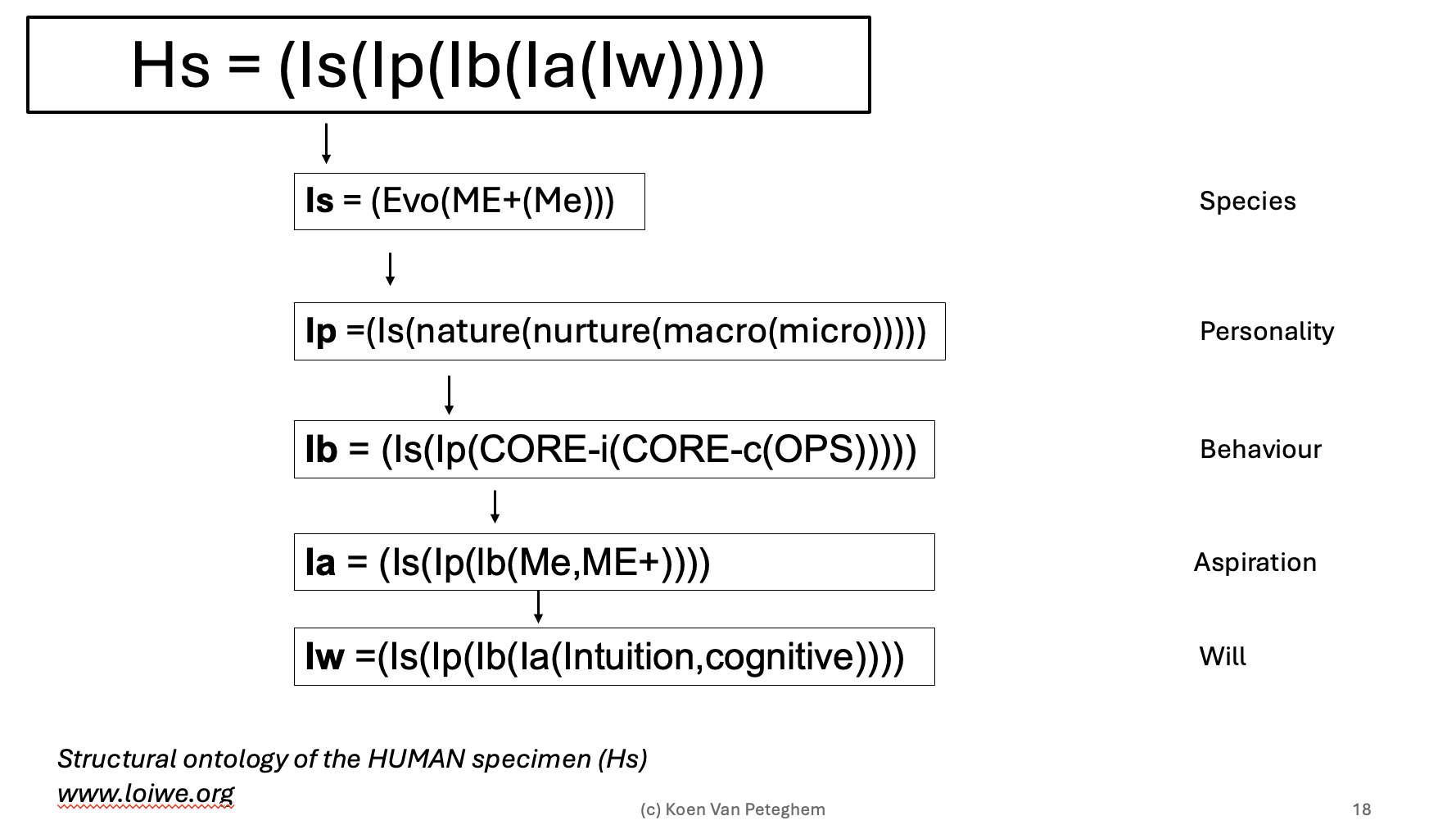
The Law Of Human Being
0. OBSERVATIONS:
The Myth of the Solatary Soul
We are witnessing the end of a grand experiment. For four centuries, the West has built its entire world on a single, powerful assumption: that the human being is a sovereign individual—a point of consciousness that exists independently of its environment. We called this model the "Species of One." It promised that if we could just strip away the shackles of tradition, religion, and social obligation, we would find a pure, liberated self that could finally be happy. We made personal freedom the holy grail of our civilization. Economics optimized for our choices, psychology focused on our internal states, and politics fought for our rights.
But as we stand in the mid-2020s, the data from the real world is delivering a different verdict. In the very societies that have achieved the highest levels of prosperity and freedom, people are not thriving; they are caving in. When roughly one-quarter of the world’s population—the most educated, the best protected, and the most wealthy—is experiencing a terminal state of mental exhaustion, social fragmentation, and anxiety, we must admit that our map of the human being is fundamentally broken. We have reached the ceiling of our aspirations, only to find that we are losing ourselves. We have achieved the ultimate goal of freedom, yet we fear a looming dystopia.
The error lies in our failure to recognize a simple biological truth: in nature, singularity is an impossibility. No species survives as a collection of isolated units. Humans are a mammalian species, and mammals are characterized by a total, inescapable dependence on the group. At no point in our lives can we survive alone. Even those who attempt to live "wild" are utilizing tools, languages, and survival strategies that were forged by a collective over millions of years. We are not a "Species of One"; we are a nested species.
Yet, for centuries, we have allowed philosophy, economics, and psychology to dominate our perception of who we are, while pushing sociology and anthropology to the sidelines. We treated our social connections as optional décor rather than as the load-bearing pillars of our existence. We also ignored the factor of time. We saw time as a linear passing of minutes, not as a matrix of change. For most of history, the speed of change was slow enough that our unbolted structures could survive the friction. But in the last 165 years, and especially since the turn of this century, the impact of its speed, acceleration, breadth, and depth has reached a level that the isolated individual was never designed to process.
When you look outside with clear eyes, the reality is undeniable. We are a biological species, we are specific specimens of that species, and we are a continuous stream of interactions. We act, react, and—most importantly—interact. We behave differently in a group than we do alone because we are wired for plurality. We are all these layers at once, all the time. This plural nature is not an opinion; it is a claim that is impossible to deny. It lays to rest the notion of the human as a "Species of One" and reveals the reassembled specimen, defined by the formula:
[Hs = (Is(Ip(Ib(Ia(Iw)))))]
We find our true weight and our true freedom not in our independence, but in our connectedness. The map of repair begins not with more liberation, but with a sober recognition that we are already, and necessarily, bound.
Evo. The Matrix Of Change.
For most of our history, we have treated time as a passive backdrop—a linear sequence of dates moving from past to future. We saw it as a clock on the wall, something to be accepted but not something that actively determines who we are. This was a sustainable view when the rate of change was slow enough that one generation’s world looked almost identical to the next. But for the modern Human Specimen, time is no longer a neutral line. It has transformed into a high-pressure current of friction that we call Evo.
In this ontology, "Evo" is not just biological evolution in the distant past; it is the active matrix of change we inhabit right now. We cannot understand our current state of unsteadiness without recognizing that change has a specific, measurable structure. We define this load through the formula: Evo = (Speed, Acceleration, Breadth, Depth). These four metrics determine whether our internal structures hold firm or whether we experience the "sinking feeling" of a floor caving in.
Speed refers to the baseline frequency of change in our environment. It is the rate at which our tools, our jobs, and our social information are updated. When speed is high, our conscious minds are forced to spend all their energy on processing new data rather than navigating toward a goal. Acceleration is the even more stressful rate at which that speed itself increases. It is the primary cause of modern vertigo. Our biological hardware was designed to track constant velocities, but it reacts to rapid acceleration as a terminal threat. When the world moves faster today than it did yesterday, our internal "Map" becomes obsolete before we can even use it.
Breadth measures the complexity of the stress. It describes how many domains of our lives are shifting at the same time. In the past, a crisis might be limited to one area—perhaps an economic downturn or a change in local leadership. Today, we face "High-Breadth" change: our technology, our family structures, our economic rules, and our climate are all transforming simultaneously. This prevents us from using one stable part of our life to anchor another. Finally, Depth indicates how far the change cuts into our core. It is the difference between a change in fashion (which is shallow and optional) and a change in the meaning of truth or the sanctity of life (which is deep and structural).
The mismatch of our era is that our deep biological hardware moves at a slow, evolutionary pace, while our surface technological layer moves almost vertically. We are mammals with ancient needs for rhythm, safety, and slow-grown trust, but we are being forced to live at the speed of light. This creates a state of permanent "Metabolic Red-lining." We feel gefragmented and exhausted because the "fast layers" of our world are tearing the "slow layers" of our souls apart.
Accepting the reality of Evo is the first step toward structural repair. We must stop seeing change as a series of random events and start seeing it as a predictable load on a limited system. We cannot slow the world down, but we can increase our "Structural Mass." By identifying the few things that do not move—the core invariants of our floor—we can build the "seatbelts" required to survive the acceleration. We move from being victims of the current to being navigators of the vector.
II. Diagnosis: The Ceiling Of Freedom And The Caving Floor Of Existence
We live in a state of profound and pervasive unsteadiness. Across the globe, individuals and institutions are reporting a persistent sense of vertigo—the visceral feeling that the ground beneath our feet is no longer solid. This is not a temporary political or economic crisis; it is a structural failure of our most fundamental map of reality. We have reached a point where the "Species of One" (So1) model, which treats the human being as a sovereign, self-contained singularity, is no longer functional. We are currently experiencing two simultaneous collisions: the Human Specimen (Hs) is hitting the ceiling of his own aspirations, while the floor he stands on is caving in.
The "Ceiling" represents the hard, biological limit of our metabolic and cognitive capacity. For centuries, our culture has encouraged a "Vertical Escape"—the belief that we can continuously reinvent ourselves at the speed of light. We treat our lives as software projects that can be updated with new identities and moral codes every morning. However, the reality of the Human Specimen (Hs) is governed by a strict 10/90 Ratio. Only about 10% of our existence consists of our conscious, steerable Will (Iw). The remaining 90% is the "Structural Mass" of our biological hardware (Nature), our instinctive requirements for safety (CORE-i), and the deep-coded cultural software we inherited (CORE-c).
By reaching for a ceiling of infinite choice, we have forced our tiny 10% agential fraction to take on the manual maintenance of the entire 90% mass. We are attempting to "will" our own safety, "will" our own meaning, and "will" our own social standing in a vacuum. We are simply running out of "Agential Joules." We have hit a metabolic wall; we do not have the internal energy required to be the sovereign gods we aspire to be. This is why we are exhausted—not because we are working too hard in the physical world, but because we are performing exhausting "metaphysical labour" to keep a non-existent sovereign floor from vanishing.
While we are hitting this ceiling, the "Floor" is caving in. The floor is composed of our "Nests"—the families, communities, and shared truths (ME+) that historically absorbed the weight of our existence. Under the guise of liberation, we have spent sixty years systematically unbolting the "Bolts" of this social lattice. We assumed the floor was a natural "given" that would always be there, but it was actually a structure that required constant input from Maintainers (M). We viewed anchors like tradition, obligation, and fixed roles as shackles to be removed. But in tearing down the walls of our home, we did not create a boundless open plain; we created a wind tunnel.
The result of this double collision is "Decomposure." This is the internal, bodily sensation of a structural collapse. It is that "sinking feeling" where the energy leaves your extremities and retreats to the centre in a desperate bid to brace for a crash. We see the diagnostic evidence in a generation of twenty-five-year-olds who are already "red-lining" their engines, hitting terminal burnout before their lives have even truly begun. They are not "fragile"; they are specimens who have been placed in an uninhabitable environment.
We must accept the hard truth: the experiment of the "Sovereign Individual" has failed to provide a stable existence. We have reached the endpoint of "unshackling." There are no more chains to cut that will not also cut the arteries of our survival. The unsteadiness of our time is the signal that we have pushed the Human Specimen beyond its design limits. To survive, we must move from the "Active Delusion" of sovereign autonomy to the "Sober Recognition" that we are nested, limited, and bound. We find our true power and our real freedom not in being "unshackled," but in rebuilding the floor and accepting our role as its stewards.
III. Hs - The Human Specimen
[Hs = (Is(Ip(Ib(Ia(Iw)))))]
To move beyond the failure of the "Species of One," we must reassemble the human being from the ground up. We need a model that doesn’t just describe how we feel, but specifies how we function. We call this reassembled entity the Human Specimen (Hs). The Hs is not a single, floating point of consciousness; it is the fused core of four distinct layers that answer the four fundamental interrogations of our existence. These layers are stacked and nested, meaning the integrity of the top depends entirely on the stability of the bottom. We express this total structure through the formula:
[Hs = (Is(Ip(Ib(Ia(Iw)))))]
The first interrogation is: What am I? The answer is Identity (I). In this framework, identity is the outermost bracket, the foundational floor. We have been conditioned to think that "I" is something private we find inside ourselves. But the structural reality is that you are your Connectedness. Identity is the "Verb" of being tied to a living body, a collective "WE," and a current of time. You are a node in a circuit. If you are unbolted from your community or your history, you do not become "free"; you become "nothing." Identity is the base mass that allows the rest of the specimen to exist. It is the "What" that provides the gravity for everything else.
The second interrogation is: Who am I? The answer is Personality (Ip). If Identity tells us what we are (a nested connection), Personality tells us the specific shape of our particular unit. We define this as the Architecture of Limits. This is the realization that you are not a "blank slate" of infinite potential, but a specimen with fixed biological hardware and deep-coded environmental software. Your personality is the geometry of your limits—your specific temperament, your metabolic speed, and the scripts installed during your upbringing. These are the "Walls" of your home. They are not obstacles to your freedom; they are the very things that give your life definition and grip.
The third interrogation is: How am I? The answer is Behaviour (Ib). This is the "Engine" of the specimen. As we have seen, behavior is not a simple, isolated choice made by a sovereign mind. It is the Resultant Vector of three internal operating systems: your animal instincts for safety (CORE-i), your cultural stories of meaning (CORE-c), and the technical routine of your daily life (OPS). When these systems are misaligned—when your routine ignores your need for belonging or your soul's need for a story—the engine vibrates and red-lines. Behaviour is the compromise your body reaches to keep the machine running.
The fourth and final interrogation is: In how far am I? The answer is Will (Iw). This is the most humbling part of the reassembly. Your conscious will—the part of you that chooses and aims—is the Usable Bandwidth of the specimen. It is the 10% tip of the iceberg. It is the agential fraction that can steer the ship, but it cannot move the ocean. Your Will is the smallest bracket because it is the most dependent. It can only function if the Behaviour engine is aligned, the Personality walls are accepted, and the Identity floor is solid.
The Hs model is a "Heavy" model. It acknowledges that we are 90% structural mass and only 10% conscious steering. By fusing these four answers into one formula—[Hs = (Is(Ip(Ib(Ia(Iw)))))]—we gain the Relief of Soundness. We stop the "Active Delusion" of trying to be sovereign gods and accept the "Sober Recognition" of being Stewards. We realize that our power does not come from being "unshackled" from our nature, but from mastering the architecture we actually inhabit. When the brackets are aligned, the Human Specimen moves with an integrity that the "Species of One" can never achieve. We are no longer floating; we are anchored.
IV. I - identity - What Are We? The Species.
To answer the first interrogation—What are We ?—we must look away from our internal feelings and toward our structural bindings. In the modern world, we have been conditioned to believe that identity is a private, internal treasure, a "true self" hidden deep within the biological unit. We act as if we could be stripped of our family, our language, our history, and our country, and still somehow remain essentially "ourselves."
The structural ontology reveals this to be a terminal error. In reality, Identity (I) is not an internal possession; it is the Verb of Connectedness. We define this foundational layer through the formula:
Is = (Evo(ME+(Me)))
This formula specifies that the human being is not a point of light, but a quality of tension between three necessary brackets. To understand the "What," we must analyze these brackets in the order of their containment.
The first and innermost bracket is the (Me). This is the aware unit, the biological organism with its sensory hardware and its unique vantage point. It is the necessary aperture through which life is experienced. However, in isolation, the (Me) is a structural non-entity. It possesses the capacity for awareness but lacks the "code" required for identity. Without the outer brackets, a human (Me) is merely a feral biological specimen. It has no name, no concept of "I," and no way to navigate a world of reasons. The (Me) is the hardware, but it is powerless without a network.
The second bracket is the (ME+). This is the collective field, the "Nest." It is the web of relationships, the shared language, the unwritten covenants of trust, and the social recognition that provides the (Me) with its subject-status. You cannot name yourself in a language you didn't invent. You cannot be a "self" without a "mirror" in the form of an other. Identity requires Mutual Recognition. To be human is to be of the group, not just in it. When we ignore this bracket—when we attempt to live as a "Species of One"—our identity loses its structural mass. We become "lightweight" and begin to drift, which is why social isolation is registered by the human hardware as a terminal threat, equivalent to physical damage.
The third and outermost bracket is (Evo). This is the temporal current, the relentless friction of change that carries both the individual and the collective. Identity is not a static snapshot; it is a Temporal Projection. You are a continuity that includes your biological past, your cultural heritage, and your projected future. If you decouple the (Me) from the current of time—if you live only in a series of disconnected "presents"—the formula for Identity cannot be completed. You lose your momentum and your "Grip" on reality.
We were taught to see time as a passive background—a linear line of dates that merely passes by. But for the Human Specimen (Hs) , time is not a neutral backdrop; it is the active medium of change. It is the current in which we swim and the friction that defines our shape.
Evo is a structural requirement of our identity. It is the "Current" in the bracketing Is = (Evo(ME+(Me))). Without change, there is no life, no story, and no "I." But change is not a simple, flat constant. As we have established, it is a matrix defined by its Speed, Acceleration, Breadth, and Depth. In this ontology, we recognize that Evo—as the force of change—is key to our species in three essential ways: as temporal projection, as the biological reality of the aging agent, and as the internal capacity for evolution itself.
First, Evo is our Temporal Projection. Unlike other species, the human being is a temporally extended project. We do not live in a series of disconnected "presents." To be a functional "I," we must project ourselves backward into our history (Heritage) and forward into our future (Horizon). We remember where we came from so that we can determine where we are going. This projection is what allows the 10% agential fraction to make meaningful choices. If we are decoupled from this temporal bracket—if we live only for the immediate "Now"—the identity formula becomes mathematically incomplete, and the specimen loses its grip on reality.
Second, we must recognize the reality of the Aging Agent. Evo is not just external history; it is internal biological fact. We are specimens in a lifecycle. We move from the total dependency of the Nucleus through the expansion of the Mesh to the responsibility of the Steward. To deny this aging process is to commit a category error. We cannot live as if our hardware is permanent and static. Accepting that we are "aging agents" allows us to align our daily routine (OPS) with our biological reality, ensuring we move from "Production" to "Stewardship" as we mature.
Third, we carry the Capacity for Change within us. We are magnetized by "nextness." This is visible in our biological neuroplasticity and our cultural adaptability. We are the only species that can consciously choose to evolve its own behavior. This drive is so deep that when change is blocked, we experience the signal of Boredom—which is not a trivial discomfort, but an alarm system warning us that our structure is becoming inert. To be human is to need to evolve, to update our "How" to match the shifting "What" of the world.
However, the most crucial finding of the Hs Law is that this capacity for change is Limited. The modern experiment failed because it assumed we are "infinitely elastic"—that we can change our identities, our genders, and our moral codes at any speed we choose. But change has a metabolic cost. We possess a finite amount of "Agential Joules" to process transformation. If the speed and acceleration of Evo exceed our structural bandwidth, the identity muscle does not grow; it tears.
We carry the power to change, but we must do so within our Architecture of Limits.
V. Ip - Personality - Who Am I: Specifics Of The Specimen
If Identity answers the question What are we? by identifying our universal nesting within the group and time, Personality (Ip) answers the second interrogation: Who am I?. In our current culture, we are told that "potential is limitless" and that we can be anything we want. This is a cruel myth that leads to a life of permanent inadequacy and burnout. In the structural ontology, your personality is not a collection of fluid traits or a "vibe"; it is technically defined as the Architecture of Limits. It is the specific, finite geometry of your life.
This geometry is defined by the formula:
Ip = (Is(Nature(Nurture(Macro(Micro)))))
It specifies that your "Who" is a nested refinement of your identity. It is the result of your Biological Nature setting the ceiling of your capacity, and your Nurture—the sequential training you received in two distinct developmental nests—determining the floor of your reality. These limits are not a prison; they are the walls that give your structure its shape. A room is only useful because it has walls that define where it ends and what it is for.
The audit of the specimen begins with Nature (The Biological Hardware). Modern research in behavioral genetics, summarized by Robert Plomin (2018), proves that approximately 50% of the variance in human temperament and cognitive capacity is heritable. This provides the "Hardware Invariants" of the Hs your cognitive speed, your metabolic endurance, and your baseline nervous system reactivity. Some specimens are "high-gain" systems—highly sensitive to stress signals. To tell such a person they are "limitless" is a diagnostic error. The hardware defines the absolute limit of what your conscious will can induce.
The remaining 50% of the architecture is determined by the Nurture Sequence. We do not look at "environment" as a single block, but as two critical phases of structural installation. The first is Micro Nurture (The First Nest: Ages 0-12). This is the "Boot-Sequence" for the instinctive hardware (CORE-i). During this period, the parental and sibling field installs the first patterns of safety and trust. If the first nest was unstable, the specimen enters adulthood with a "Primary Debt": a nervous system that is permanently set to high-alarm, consuming bandwidth that should be used for navigation.
The second phase is Macro Nurture (The Expanded Nest: Ages 12-25). This is the period of social and cultural installation, where the Hs navigates the wider ME+ (peers, mentors, and institutions). This phase is responsible for installing the CORE-c (The Cultural Core) software. It is when the agent acquires the stories of meaning and the "Orientation Gradient" required to function as an adult. If this nest is hollow or provides "Poisoned Code" (like Internalized Perpetual Doubt), the specimen fails to develop a stable directional vector.
Knowing your "Architecture of Limits" offers Forgiveness through Clarity. In the "Species of One" model, you are 100% responsible for your failures, which creates the metabolic "tax" of shame. In the Hs model, you recognize that your temperament is hardware and your upbringing is software. You move from the "Active Delusion" of being a self-created god to the "Sober Recognition" of being a Steward of a Specific Specimen.
Repair begins when you stop trying to "will" yourself into a different specimen and start Optimizing the Architecture you actually possess. You find your power not by breaking your walls, but by decorating the room you live in. When the agential map aligns with the hardware limits, the internal friction vanishes. You move from "Pathology" to "Calibration," allowing your 10% bandwidth to be used for strategic stewardship rather than futile internal firefighting.
VI. Ib - behaviour - How Am I? Expression Of The Personality
Human behaviour is often the most confusing part of our existence. We frequently wonder why we act against our own best interests, why we feel "paralyzed" despite having a clear plan, or why we experience a sudden surge of rage in a situation that demands professional calm. Traditional psychology often blames these inconsistencies on a "lack of character" or a "hidden trauma." The structural ontology offers a more precise, mechanical explanation. We do not answer the question How am I? by looking at a single decision; we answer it by identifying the Resultant Vector of our internal systems.
We define this through the formula:
Ib = (Ip(Core-i(Core-c(OPS))))
This formula shows that your behaviour (Ib) is the final output of three concurrent operating systems, all of which are filtering through the unique walls of your personality (Ip). To understand why you do what you do, you must understand the three "voices" that generate your actions.
The first and loudest voice is CORE-i (The Instinctive Core). This is your ancient mammalian machinery, located deep in your nervous system. It does not use logic or language; it speaks in the code of physical arousal: tension, heartbeat, and breath. Its non-negotiable requirement is biological safety and tribal belonging. If your CORE-i registers a threat—whether it is a physical predator or the "social death" of being ignored by your peers—it triggers a high-energy alarm. Because this is the innermost layer, its signal is the most powerful. When the CORE-i screams "Danger," it can instantly hijack your higher functions.
The second voice is CORE-c (The Cultural Core). This is the layer of "Sacred Stories" we absorbed during our development. It provides the software of meaning—the "Why" behind our actions. It houses our moral horizons and the traditions that tell us what is "Honorable" or "Good." This system provides the Orientation Gradient; it tells the body that certain directions are worth the metabolic cost of movement. Without a functioning CORE-c, the specimen enters a state of anomie—a hollowing out of purpose that leads to terminal passivity.
The third voice is OPS (The Operational Layer). This is the modern, technical machinery of daily life: the schedules, the professional roles, the digital routines, and the logic of efficiency. This is the "How" of our existence.
The unsteadiness of modern life is technically diagnosed as Layer-Misalignment. We feel fragmented because our three voices are issuing contradictory commands. Your OPS routine might demand ten hours of high-velocity digital output, but your CORE-i hardware is screaming for physical proximity and rest, while your CORE-c soul is whispering that the work is meaningless. We are like engines where the cylinders are firing out of sync—the machine shakes, red-lines, and eventually seizes.
Practical: The "Lying Flat" Phenomenon
The mechanics of the Ib formula are visible in the global "Quiet Quitting" and "Lying Flat" movements. Modernity has allowed the OPS layer to become imperial; we have optimized our lives for "productivity" while starving our biological and cultural cores.
From a biological standpoint, this is validated by Polyvagal Theory (Porges, 2011). When the environment provides high OPS demands but zero CORE-i safety signals (like facial micro-expressions or physical presence), the nervous system enters a state of "Freeze." This isn't laziness; it is a Systemic Shutdown. Similarly, when the CORE-c (Meaning) is liquidated by transactional work, the specimen loses its "potential difference"—the energy required to act. Repair is not found in a better "productivity hack" (which is just more OPS), but in Re-Aligning the Strata: ensuring that your daily "How" respects your mammalian "Safety" and serves your human "Why."
VII. Iw - Will - Bandwith In My Behaviour.
The final and perhaps most humbling interrogation of the self is: In how far am I? Our modern culture is built on the "Active Delusion" of the Sovereign Will. We are raised to believe that we are the absolute captains of our fate, that our conscious choices are the primary engine of our lives, and that any failure to achieve our goals is a simple deficit of willpower. We treat our minds like infinite batteries. The structural ontology provides a harsh but necessary correction: your conscious agency is a limited resource governed by the 10/90 Ratio.
We define the extent of the self through the formula:
Iw =(Is(Ip(Ib(Agency))))
This formula specifies that the Will (Iw) is the innermost and most fragile bracket. It is nested within the cumulative constraints of your Behaviour (Ib), your Personality (Ip), and your foundation of Identity (I). In technical terms, your conscious agency is the 10% "tip of the iceberg." The remaining 90% is the structural mass of your biological hardware, ancient instincts, and deep-coded culture drifting beneath the waterline of awareness. Conscious agency is not a "First Cause" that creates your life from nothing; it is a Usable Bandwidth—a steering mechanism that allows you to modulate the massive systems already in motion.
The "Species of One" model fails because it ignores this ratio. It encourages Bandwidth Overestimation, telling you that you can use your 10% fraction to manually override 90% failures. We try to "will" ourselves out of biological depression, "will" ourselves to be brave when our nervous system is in a state of high-alarm, or "will" a sense of purpose when our social nest has dissolved. This is like a captain trying to move a massive iceberg by pushing against the railing of his ship. It does not move the iceberg, but it does exhaust the captain. This is the technical cause of modern burnout: metabolic energy is liquidated by the impossible task of maintaining a sovereign floor.
Practical: The Latency of Consciousness and Decision Fatigue
The 10/90 Ratio is not a philosophical metaphor; it is supported by foundational neuro-technical research. Benjamin Libet’s (1985) experiments on the "Readiness Potential" demonstrated that the brain’s motor cortex initiates the electrical signal for an action—the 90% mass—nearly half a second before the conscious mind—the 10% fraction—becomes aware of any "decision" to act. Later studies using fMRI (Soon et al., 2008) have extended this finding, showing that brain activity can predict a choice up to ten seconds before the person is aware of making it. This proves that the Will functions not as the "Creator," but as a Veto-Power and a Stewardship Interface.
This biological limit is further evidenced by the phenomenon of Decision Fatigue. Research by Roy Baumeister (1998) shows that conscious agency is a finite metabolic resource that depletes glucose. When a specimen is forced to make too many conscious decisions in an unanchored environment, the 10% bandwidth "red-lines." Once exhausted, the agent loses the ability to steer and reverts to "Default Settings"—mammalian instincts (CORE-i) and rigid habits. Success is not found in "more willpower," but in Strategic Stewardship: using your limited 10% bandwidth to adjust the environment (ME+) and the routine (OPS) so that the 90% mass receives better signals. You don't "will" the floor into existence; you rely on the Covenant to automate your stability, preserving your precious bandwidth for actual navigation.
VIII. Me+ - Belonging - The Us in Me. Or Us
If the Human Specimen (Hs) is the unit of life, then the ME+ is the "Nest" that makes that unit functional. In our modern culture of individual sovereignty, we have been taught to view society as a collection of choices—a series of optional clubs we join or leave at our convenience. The structural ontology reveals that the collective field is not an elective association; it is a Biological and Structural Requirement. Just as a lung cannot function without the atmosphere, the "Me" possesses zero agential status without the "WE."
We define the architecture of this nest through the formula: ME+ = (((Micro) Macro) Meta). This formula shows that belonging is a three-level hierarchy. The Micro is the family nucleus—the first bracket where your hardware boots up. The Macro is the "Middle Field"—the neighborhood, the workplace, and the local associations where we practice the skills of cooperation. The Meta is the civilizational roof—the state, the global economy, and the international order. In a functional system, the Macro acts as a shock absorber, protecting the Micro from the high-velocity shifts of the Meta.
The tragedy of the modern West is that we have "unbolted" this structure in the name of efficiency and total freedom. We have optimized for the Meta—the frictionless flow of global capital and digital information—while systematically liquidating the Macro—the local bonds of neighborhood and community. We have traded the "Thick WE" of shared responsibility for the "Thin WE" of the contract. This has left the individual Hs standing "unbelted" in a high-velocity wind tunnel. When a crisis hits at the Meta-level (like a global pandemic or economic crash), there is no Macro-level buffer left to catch the individual. The load is transferred directly onto the individual’s 10% agential fraction, leading to the systemic exhaustion we see everywhere.
Practical Data: Social Capital and the Biology of Isolation.
The collapse of the ME+ bracket is documented by decades of sociological research. Robert Putnam’s landmark work, Bowling Alone (2000), provided the first large-scale evidence of the hollowing out of the "Macro" layer. His data showed a terminal decline in civic engagement, trust, and neighborly interaction—the "Bolts" of our social structure. Since 2000, this trend has only accelerated, with the World Happiness Report (2024) showing that "social support" is the strongest predictor of systemic stability, far outweighing GDP.
From a biological standpoint, the lack of a supporting ME+ is a hardware catastrophe. Research by John Cacioppo (2008) on the "Biology of Loneliness" proves that when the human specimen feels socially unmoored, the CORE-i system registers a "High-Consequence" threat. This triggers a permanent release of cortisol and a state of chronic inflammation. Biologically, we are not designed to be "Sovereign Individuals"; we are wired to assume that we are safe only when we are nested. When we unbolt the ME+, we don't become "free"; we become "prey." The unsteadiness of modern life is the signal that the Hs is currently red-lining because the "Nest" no longer absorbs the weight of existence. We tell people to "go touch grass," but we have sold the meadow to the market.
IX. Transduction - Micro/Macro/ Meta : The Wiring Of The Circuit
The final mystery of our modern unsteadiness is why a failure in a distant capital or a shift in a global market feels like a "sinking feeling" in our own chests. Why does institutional decay in the "Meta" world result in a panic attack in the "Micro" world of the bedroom? The answer lies in the process of Transduction. This is the mechanical wiring of our species. It is the process by which structural load, agential energy, or information is translated across the nested brackets of our existence. Because we are structurally coupled, there is no such thing as an "isolated" crisis.
Transduction is based on a simple law: the "Nest" (ME+) of one level is the "Unit" (Me) of the next. Your family is your nest, but your family is also a single unit within the neighborhood. The neighborhood is a unit within the city, and the city is a unit within the state. This means that any "debt" or "surplus" created at one level is technically "poured" into the next. We are not isolated atoms; we are a single agential circuit. If the circuit is broken at any point, the electricity stops flowing for everyone.
Upward Transduction is what happens when individuals are exhausted. As we have seen, the Human Specimen (Hs) has a limited 10% agential bandwidth. When the social floor is unbolted, we use that bandwidth to manually perform the maintenance of our own safety and meaning. When we are "tapped out," we stop providing maintenance energy (M) to the community. We stop volunteering, we stop checking on neighbors, and we stop participating in shared rituals. This causes the "Macro" nest to lose its structural mass. If enough individuals burn out, the institutions decay, and the entire state eventually loses its legitimacy. The individual's internal "Decomposure" transduces into the collective "Decomposition."
Downward Transduction is the reverse. When the State or the global order (the Meta-level) violates the truth or fails to maintain justice, it injects "noise" into the system. This corruption flows down through the media, the schools, and the digital algorithms into the individual’s "Cultural Core." The person receives a "Poisoned Code"—a non-functional map of the world—leading to the internal sensation of the floor turning into liquid. You aren't "depressed" in a vacuum; you are a component in a vibrating structure that has lost its lead shield.
Practical Data: The Marmot Review and the Biology of the Field
The reality of Downward Transduction is documented by the Marmot Review (2010/2020) on health inequalities. Sir Michael Marmot’s research proved that "Social Determinants"—the quality of the ME+ bracket—correlate directly with the biological hardware (Me). People living in environments with low "Structural Impedance" (lack of justice, safety, and stable roles) show a measurable spike in chronic inflammation and a significantly reduced life expectancy.
This proves that stress is not a "feeling"; it is the transduction of structural debt into the human body. Similarly, research into "Emotional Contagion" on digital platforms (Kramer et al., 2014) shows that Meta-level algorithmic shifts can manipulate the emotional "CORE-i" baseline of millions of individuals simultaneously. We are currently approaching Scale Resonance—the terminal point where failure at the individual, institutional, and state levels matches in frequency.
When the floor, the walls, and the roof all vibrate at the same rate, the building comes down. For the Serious Agent, repair is not a personal choice; it is a thermodynamic requirement to prevent the entire circuit from melting down.
X. Transcultural: The Universal Floor
We often hear that any single way of seeing the world is a "Western imposition." We are told that values are relative and that every culture has its own unique truth. But the structural ontology reveals that the exact opposite is true: it is the "Species of One" (So1) model that is the local Western anomaly. The idea of the sovereign, un-nested individual is a technical malfunction of a specific historical moment in Europe and America. In contrast, the model of the Nested Steward is the Universal Human Baseline. By looking at the primary threads of human wisdom across history and geography, we find that the "Condensed Centre" is the point where all successful civilizations have anchored themselves.
In the African tradition of Ubuntu, we find the most direct somatic expression of our identity formula. The axiom "A person is a person through other persons" is the linguistic realization that the (Me) possesses zero structural mass in isolation. It recognizes that identity—Is = (Evo(ME+(Me)))—is a verb of contribution. You are not "born" a person; you "achieve" personhood by fulfilling your duties to the nest. This is a technical maintenance model that kept communities stable for millennia by ensuring that the collective bracket was always heavier than the individual unit.
In the East Asian traditions of Confucianism and Taoism, we find the manual for the Architecture of Limits (Ip) and the 10/90 Ratio. Confucianism specifies that a "Who" is defined entirely by its boundaries and roles. To be "Independent" is not a goal; it is a state of structural incompletion. Taoism provides the ultimate calibration of the Will (Iw) through the concept of Wu Wei (aligned action). It teaches the Serious Agent to stop "willing" against the 90% structural mass of nature and instead steer the 10% conscious tip in alignment with the current of Evo.
The Indian traditions of Dharma and Maya provide the technical validation for our Meta-Ontology of Truth. Dharma is literally defined as "that which upholds." It is the Core Inventory—the recognition that there is a "Law of the Floor" that supports all of reality. Maya identifies the high-entropy noise of the Penumbra, warning the agent not to mistake the shifting "wallpaper" of desire and narrative for the solid "pillars" of the invariants. Even the Greco-Roman Stoicsidentified the 10/90 Ratio, teaching that wisdom lies in focusing our small agency on what we can control while accepting the rest as unalterable bedrock.
The unsteadiness of the modern West is the result of attempting to run a civilization using none of these strands. We have treated the "Species of One" as a universal truth, but it is actually a structural parasite that is currently liquidating the global floor. Through the "Digital Acid" of modern technology and economic extraction, we have exported this error to every corner of the earth. Recomposition is not a "Western project"; it is the task of the entire species to return to the Sovereignty of the Bound. The structural ontology is the technical repatriation of the truth that every resilient culture once knew, but the modern West forgot.
Practical: Cultural Neuroscience and the Failure of the So1 Export
The universality of the nested self is supported by Cultural Neuroscience (Markus & Kitayama, 1991). Their research proves that the "Independent Self" (So1) is a statistical outlier, found primarily in a small subset of Western populations. The vast majority of the human species operates on an "Interdependent Self-Construal," which matches the Is = (Evo(ME+(Me))) bracketing.
The danger of exporting the So1 model is validated by Evolutionary Game Theory, specifically Robert Axelrod’s (1984) research on reciprocity. Axelrod proved that a system based on "Sovereign Extraction" (Parasitism) is mathematically self-terminating. When the West exports the So1 model to traditional cultures, it systematically dismantles their Structural Impedance—their internal "Lead Shields."
Data from the Global Social Progress Index shows that as traditional "Maintainer" (M) cultures adopt Western "Consumerist" (P) habits, they experience a rapid drop in their Sustainability Coefficient (SC). They don't become "freer"; they enter the same state of Decomposure and institutional decay. We are currently witnessing the first truly Global So1 Crash, where the coupled scales of human existence are reaching a state of Scale Resonance. The only actionable solution is a global return to the "Floor"—the common invariants recognized by the Triple Helix of Wisdom.
XI. Transdiscipline: The Universal Diagnostic
The primary agential value of this technical map is not "better measurement," but "Better Placement." We live in an era of extreme specialization. We have experts for the mind, the economy, the community, and the state. Each of these fields possesses vast amounts of data and sophisticated tools, yet they are "locally blind" by design. They operate in silos, treating their specific domain as if it were a sovereign island. This fragmented approach is the academic version of the "Species of One" error. It prevents us from seeing the "wiring" that connects the individual to the civilization. The structural ontology acts as a Meta-Diagnostic Interface that orients all existing disciplines within a single coordinate system.
The "Specialness" of this framework lies in its ability to explain why all our specialized "solutions" seem to fail simultaneously. In technical terms, each discipline is trying to fix one part of a circuit while leaving the others broken. Psychology fails when it attempts to treat the individual (Me) without fixing the decomposing nest (ME+). Sociology fails when it attempts social reforms without addressing the agential energy flow of the economy. Economics fails when it treats the market as a closed system, ignoring that trust and legitimacy are the biological prerequisites for trade. Each field is trying to solve a puzzle with pieces that belong to another domain.
When we understand the Transdisciplinary Power of the map, the hierarchy of repair becomes clear. We move from "Symptom Management" to "Stratum Audit."
In Clinical Psychology, we stop asking only "How do you feel?" and start asking "Which bracket of your identity has lost its floor?". In Sociology, we move from descriptive trends to Bracket Integrity; we identify social polarization not as a conflict of ideas, but as a technical failure of the mutual recognition loops. In Economics, we move from "Growth" to "Sustainability," redefining wealth not as the velocity of money, but as the Maintenance Surplus required to keep the human structure upright. In Politics, we move from "Messaging" to "Strategic Stewardship," recognizing that a leader is an "Extended Serious Agent" responsible for the resultant vector of the whole.
This framework does not replace the expert; it provides the expert with a Compass. For the Serious Agent—the CEO, the doctor, the parent, or the policymaker—this provides Diagnostic Certainty. You no longer have to guess why your system is "unsteady." You use the map to locate the Maintenance Debt across the strata. You stop applying operational technical fixes (OPS) to structural outages (Core). By identifying whether a "Crash" is a failure of Identity (Connectedness), Personality (Limits), Behaviour (Operating Systems), or Will (Bandwidth), you can finally orient your response toward a repair that actually holds. In an age of accelerating complexity, this structural ordering is the difference between meaningful action and terminal repetition.
Practical Data: The "Circuit-Breaking" Mechanism and Systems Thinking
The requirement for a transdisciplinary interface is validated by General Systems Theory (von Bertalanffy, 1968) and research into Complex Adaptive Systems. These fields prove that in a "nested" hierarchy, the properties of the whole cannot be found in the parts. A study of "Interdisciplinary Failure" in large-scale crisis management (e.g., the 2008 financial crash or the COVID-19 pandemic) shows that the primary "Red Light" was ignored because it fell between the cracks of traditional silos.
The Agential Circuit identifies this as the "Circuit-Breaking" Mechanism. If you fix the individual's "Meaning" (CORE-c) but the system is still providing "Poisoned Code" (Downward Transduction), the individual will re-decompose within months. This is supported by the Social Determinants of Health data (Marmot, 2020), which shows that clinical outcomes are mathematically tied to the "Legitimacy" and "Justice" of the Meta-level.
The Hs Law provides the Common Code needed to bridge these gaps. It uses the same formula—I = (((Me) ME+) Evo)—at every scale. By showing that the "Family Nest," the "Corporate Mesh," and the "National Roof" all follow the same mechanical logic, the ontology enables Simultaneous Multi-Scale Repair. We move from being "specialists of the limp" to being Architects of the Circuit, ensuring that agential energy flows from the base to the roof without leaking into the void.
XII. Why It Is Law: The Sovereignty Of The Bound
We conclude with a term that often triggers resistance in a culture of infinite choice: Law. To the modern mind, a "law" sounds like a restriction on freedom, an outdated commandment, or a rigid dogma. But the Law of the Human Specimen (Hs) is none of those things. It is not a rule we have invented; it is a description of the Hard Constraints we have discovered. It is a law in the same sense as the Laws of Thermodynamics or the Law of Gravity. You do not have to "believe" in gravity for it to determine your trajectory; if you attempt to walk off a ledge, gravity provides the immediate and non-negotiable verdict.
Calling this a "Law" is a deliberate act of Structural Honesty. It marks the transition from the "Should" to the "Must." Traditional morality tells us we should be kind or that we should value community. These are framed as "nice-to-have" options for the good-hearted. The structural ontology removes this optionality. It proves that a nested being must maintain its nest, or its own "I" will terminate. It proves that an aging agent must accept its architecture of limits, or its hardware will red-line and break. This is not a "moral sermon"; it is a Functional Specification for survival.
The Law of the Human Specimen provides the "Relief of Soundness" because it identifies the Invariants—the few things that do not move when the world accelerates. In the "Species of One" (So1) model, everything is negotiable, which means the floor is always shaking. In the Hs model, the floor is Bedrock. We call it a Law because its denial triggers the three modes of Self-Damage: you lose your mind (Logic), you lose your footing (Praxis), and you lose your self (Existence). For the Serious Agent, this is the ultimate protection. It allows you to say "No" to the high-entropy noise of the world because you know where the load-bearing walls are. We find our true sovereignty not in being "unshackled" from our nature, but in the Sovereignty of the Bound—the power that comes from aligning our 10% will with the 90% mass of reality.
Practical: Dissipative Systems and the Math of Solvency
The status of this framework as "Law" is validated by Non-Equilibrium Thermodynamics and the study of Dissipative Structures (Prigogine, 1977). This Nobel-winning research proves that complex systems (like a human or a society) require a constant, specific flow of energy to maintain their order. If the "Maintenance Input" is removed, the system does not just "get messy"; it undergoes a Non-Linear Collapse.
This is further supported by Evolutionary Game Theory (Smith, 1982) and the study of Evolutionary Stable Strategies (ESS). The data confirms that certain "Behavioural Vectors"—such as pure extraction or the denial of reciprocity—are mathematically impossible to sustain over time (Evo). They lead to a "Division-by-Zero" Singularity where the system runs out of maintainers and terminates.
The SC = M / (P + V) formula is the mathematical expression of this Law. It is the Solvency Metric for human existence. In any environment—whether a family, a business, or a nation—if the number of Maintainers (M) approaches zero, the "Floor" disappears. This is why we have moved from "Opinion" to "Law." You cannot vote against the second law of thermodynamics, and you cannot build a sustainable civilization on the "Species of One" error. The unsteadiness of the West ends when we stop trying to be free from structure and start fulfilling the Duties that make existence possible.